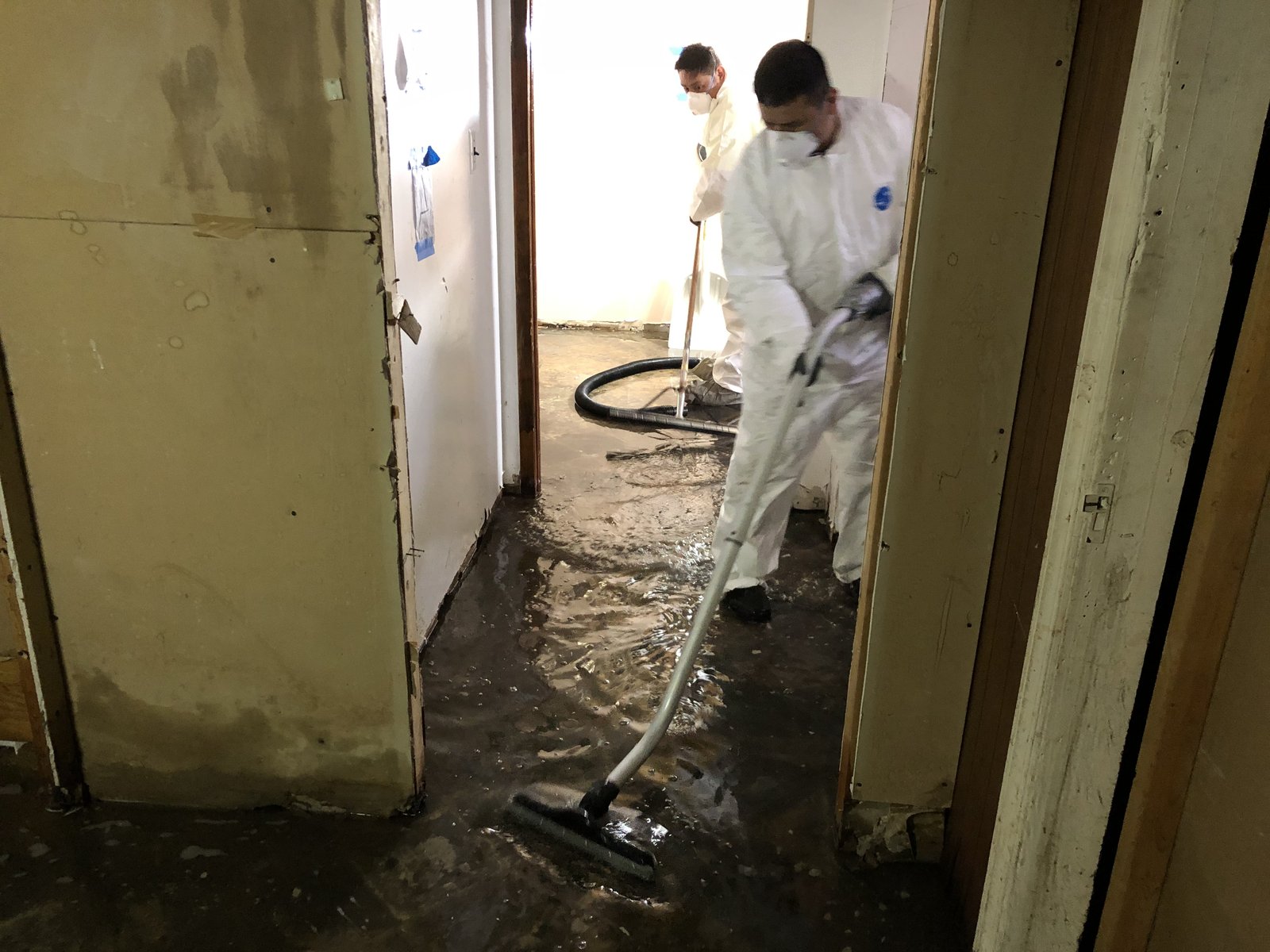
NYC HIC #1220350-DCA · Sewage Cleanup on Staten Island Since 1997
When sewage backs up, it's Category 3 black water.Containment, decontamination, and full reconstruction on Staten Island.
IICRC S500 Category 3 containment, regulated demolition, and documented EPA-listed decontamination,plus the permitted rebuild, one licensed contractor, one continuous file.
Category 3 sewage cleanup is the IICRC S500 protocol for raw-sewage events: containment of the affected area, regulated demolition of porous materials, EPA-registered antimicrobial application with documented contact time, and post-decontamination verification. Anajur Construction Corp. delivers this protocol plus the permitted rebuild that follows, under a single NYC DCWP Home Improvement Contractor license (#1220350-DCA). Most restoration vendors stop after demo and hand off the rebuild; sewage events are where that handoff costs claimants the most. One contractor, one license, one continuous file.
Sewage backup is Category 3 black water: and that designation determines every protocol that follows.
The IICRC S500 Standard for Professional Water Damage Restoration sorts every loss into one of three categories based on contamination level. Category 1 is sanitary-source water, a supply line break, a melted icicle. Category 2 is grey water, a washing machine overflow, a fish-tank failure, an aquarium spill, water with significant chemical, biological, or physical contaminants. Category 3 is black water. Sewage qualifies. Toilet overflows from beyond the trap qualify. Flood water from rivers and storm surge qualifies. Anything carrying gross contamination, pathogens, or toxigenic substances qualifies.
Most restoration vendors will tell you they handle "all three categories." What that phrase obscures is how different a Category 3 protocol actually looks from the inside. A Cat 1 loss permits in-place drying of carpet pad. A Cat 3 loss requires pad removal as biohazard waste. A Cat 1 loss tolerates one-pass surface cleaning. A Cat 3 loss requires containment before any cleanup begins, EPA-registered disinfectant application with documented dwell time, and post-decontamination verification. A Cat 1 loss is a drying problem. A Cat 3 loss is a public-health remediation that happens to involve drying.
The Category 3 designation drives five downstream decisions, each one covered in depth further down this page:
Decision 01
Demolition scope
Porous materials are removed and disposed as biohazard waste, not cleaned in place. The category sets the cut line.
Decision 02
PPE requirements
P100 respirators or PAPR, full Tyvek coveralls, nitrile gloves, and sealed eye protection, not optional on a Cat 3 site.
Decision 03
Antimicrobial selection
EPA-registered hospital-grade disinfectant matched to the pathogens present, bleach is not a substitute.
Decision 04
Waste classification
Industrial-commercial debris under 6 NYCRR Part 364, escalating to Regulated Medical Waste only on a healthcare or sharps trigger.
Decision 05
Insurance characterization
Sewer-backup endorsement vs. base policy vs. flood policy, decided by the documented origin point of the water.
For the full Category 1 / 2 / 3 framework and how each loss type is scoped, our Water Damage Restoration page covers the S500 categories in depth, including the Class 1–4 substrate classifications that govern equipment selection. This page focuses on what's specific to Category 3 sewage events, the pathogens, the protocol, the regulators, the carrier dispute patterns, and the documentation chain that decides whether the claim closes or stalls.
The Biology Inside The Water
Nine pathogens that matter when raw sewage enters your space.
Sewage carries a defined set of disease-causing organisms. NIOSH Publication 2002-149, the federal guidance on occupational exposure to wastewater-derived biosolids, catalogs the bacterial, viral, and parasitic genera that occur in sanitary sewage and identifies them as occupational hazards for workers handling that material. The pathogens below are the ones that drive PPE selection, antimicrobial selection, and salvageability decisions on a Cat 3 site. Infectious dose figures cite CDC primary sources where CDC publishes them; where CDC publishes no specific number, the page says so and points to the next-best authority.
Bacterial · Enteric
Escherichia coli O157:H7
Infectious dose as low as 10 to 100 CFU per CDC Emerging Infectious Diseases (Rangel et al., 2005). Fecal-oral transmission. Causes hemorrhagic colitis; complication risk includes hemolytic uremic syndrome in children and adults over 65.
Bacterial · Enteric
Shigella spp.
As few as 10 to 100 organisms per CDC Health Alert Network 486 (2023). Fecal-oral, with documented cross-contamination through hands, food, and surfaces. Extensively drug-resistant strains are now established in the US.
Viral · Enteric
Norovirus
Infection has been documented at as few as 18 viral particles per CDC MMWR RR-3 (Hall et al., 2011). Environmentally stable, resistant to many disinfectants, drives EPA List G product selection. Aerosolized during cleanup of vomitus or fecal contamination.
Parasitic · Protozoan
Cryptosporidium spp.
As few as 10 oocysts per CDC MMWR (2019); older surveillance reports cite a 10 to 30 oocyst range. Chlorine-resistant. Oocysts can remain infective in moist environments for two to six months. Severe and prolonged disease in immunocompromised hosts.
Parasitic · Protozoan
Giardia duodenalis
Ingestion of as few as 10 cysts has been reported to cause infection per CDC MMWR Giardiasis Surveillance (2009-2010). Cysts survive in water and on moist surfaces. Causes prolonged diarrheal disease and malabsorption.
Viral · Enteric
Rotavirus
Small infectious dose of fewer than 100 virus particles per CDC Surveillance Manual, Chapter 13. Primary cause of severe diarrheal disease in infants and young children worldwide. Environmentally stable on hard surfaces.
Bacterial · Enteric
Salmonella (non-typhoidal)
CDC does not publish a single infectious-dose figure. Estimates in the secondary literature range from approximately 103 to 106 organisms across serovars and food vehicles, per the DHS S&T Master Question List (2024). High-fat food vehicles can lower the threshold substantially.
Viral · Hepatic
Hepatitis A virus
CDC does not publish a specific infectious dose. Secondary literature describes the dose as presumptively low, with estimates of 10 to 100 virions cited in industry references. Fecal-oral transmission; environmentally stable on surfaces. CDC Yellow Book (2024) covers transmission and clinical course.
Bacterial · Spirochete
Leptospira spp.
No numeric infectious dose is appropriate. Per CDC Yellow Book (2024), transmission occurs through abrasions or cuts in the skin, through the conjunctiva and mucous membranes, and through skin macerated by prolonged water exposure. Underrecognized in urban sewage exposure.
This list is not exhaustive, sewage also carries adenoviruses, enteroviruses, Campylobacter, Yersinia, Aeromonas, and a long list of opportunistic organisms. The point is structural: nine genera with infectious doses small enough that surface cleaning is not the same thing as decontamination, and that aerosolization during cleanup is itself a transmission pathway. That fact is what justifies the containment, PPE, and antimicrobial protocols described in the next three sections.
Containment Comes First
What we do in the first thirty minutes: before any cleanup begins.
The IICRC S500 Standard's Section 12 establishes a sequence that distinguishes professional Cat 3 work from informal cleanup: containment is established before cleanup begins, not after. The reason is straightforward, once polysheeting goes up, the contaminated air inside the work area stops migrating into clean parts of the structure. Once cleanup starts in an uncontained space, aerosolized pathogens move with normal air currents into adjacent rooms, HVAC returns, and occupied space. Order of operations protects everyone in the building.
Identify the footprint and stop the source
The crew maps the affected area and any continuing source, a backed-up cleanout, a broken stack, a failed lateral, or a storm-driven sewer surcharge forced back up through an overwhelmed basement sump system. Source containment happens first; without it, water keeps coming and the rest of the protocol is moot.
Seal the work area
Every wall, doorway, and floor opening is sealed with 6-mil polysheeting, seams taped and edges sealed, isolating the contaminated zone from the rest of the structure.
Establish negative air pressure
Where the affected area abuts conditioned space, a HEPA-filtered negative-air machine pulls air out of the work area through a filter assembly rated for biological aerosols. The pressure differential keeps contaminated air from migrating outward whenever containment is breached for entry or exit.
Build the three-zone decontamination corridor
A clean staging zone for fresh PPE, a transition zone where contaminated outer PPE is removed and bagged, and the contaminated work zone itself. Workers don PPE in the clean zone, work in the contaminated zone, and reverse the process on exit, the same engineering control used in asbestos and lead abatement, applied to a biological hazard.
PPE for Cat 3 work follows OSHA's general PPE rule at 29 CFR 1910.132 and the respiratory protection standard at 29 CFR 1910.134. The respirator standard is not a recommendation. It requires a written respiratory protection program, a medical evaluation of each worker before respirator use, annual fit-testing for tight-fitting respirators, and worker training on respirator limitations. The respirator most commonly appropriate for sewage cleanup is a half-face or full-face elastomeric respirator with a P100 particulate cartridge. For extended-duration work or work involving aerosol-generating activity, a powered air-purifying respirator (PAPR) substantially reduces worker fatigue and improves the assigned protection factor. Tyvek or equivalent disposable coveralls, nitrile gloves, sealed eye protection, and rubber overboots complete the ensemble. None of this is optional. None of it is outside what a properly insured remediation contractor is supposed to be carrying on the truck.
What OSHA Actually Requires For Sewage Work
The Bloodborne Pathogens Standard reframe most restoration pages get wrong.
It is common for restoration vendor pages to claim OSHA's Bloodborne Pathogens Standard at 29 CFR 1910.1030 automatically governs sewage cleanup. It generally does not. OSHA itself addressed this question in a July 30, 2007 letter of interpretation issued in response to an inquiry from the Puerto Rico Aqueduct and Sewer Authority. The letter is on the OSHA public record and is the controlling federal interpretation.
OSHA “does not consider generally that contact with diluted raw sewage” not originating from a healthcare source to be related to bloodborne pathogens.
OSHA's position in that 2007 PRASA interpretation letter, which remains the operative federal interpretation as of May 2026, is that the Bloodborne Pathogens Standard does not generally apply to workers who handle wastewater or perform sewer maintenance work, because the contamination they encounter is not reasonably anticipated to contain human blood or other potentially infectious materials as those terms are defined in the standard. The same logic extends to ordinary residential and commercial sewage backup remediation. Without visible blood, without a healthcare-source contamination pathway, and without sharps in the wastestream, 1910.1030 is not the operative standard.
The framework that does govern ordinary sewage cleanup is a combination of four OSHA authorities working together, what they require of a competent contractor is a written hazard assessment, PPE supplied at no cost, fit-testing and medical evaluation for respirator users, and hand-washing facilities with clean potable water on site:
Authority 01
General Duty Clause
Section 5(a)(1) of the OSH Act, the employer's affirmative duty to provide a workplace free from recognized hazards likely to cause serious physical harm.
Authority 02
PPE general rule
29 CFR 1910.132, the requirement to assess hazards and provide appropriate personal protective equipment for the work.
Authority 03
Respiratory protection
29 CFR 1910.134, written program, medical evaluation, and annual fit-testing for any worker in a tight-fitting respirator.
Authority 04
Workplace sanitation
29 CFR 1910.141, hand-washing facilities and clean potable water available on the work site.
The Bloodborne Pathogens Standard is triggered, and 1910.1030 comes into full force, when the sewage event carries any one of three escalation factors. In any of those scenarios the contractor's obligations expand to a written Exposure Control Plan, hepatitis B vaccination offered at no cost to exposed employees within ten working days of initial assignment, annual bloodborne-pathogen training, sharps injury logs, and post-exposure evaluation under 1910.1030(c), (f), and (g):
Trigger 01
Healthcare source
The sewage originates from a hospital, dialysis center, diagnostic and treatment center, or clinical laboratory, where human blood and OPIM are reasonably anticipated.
Trigger 02
Blood present
Free-flowing or dried blood is present in the affected material, bringing the wastestream within the standard's definition of regulated exposure.
Trigger 03
Sharps in the wastestream
Needles, broken glass, or biohazard-labeled containers are encountered during demolition, creating a documented sharps-injury exposure pathway.
The distinction matters in two practical directions. A contractor who treats every sewage event as 1910.1030-governed inflates their PPE and documentation to a level the standard does not require, building cost into the estimate that the carrier will challenge as not reasonable and necessary. A contractor who treats no sewage event as 1910.1030-governed misses the healthcare-source escalation and exposes their crew and the building's occupants to a regulatory risk that does apply. Anajur scopes the standard to the actual source profile. That is what a properly licensed and insured remediation operation is supposed to do.
Choosing And Documenting The Disinfectant
EPA Lists B, G, H, K, and S: and why bleach is OSHA-recognized but not on any list.
Disinfectants used in Cat 3 work are not interchangeable. The EPA maintains separate efficacy lists organized by the pathogen class a registered product is proven to kill, and the right product on a sewage job is the one whose registered claim covers the organisms that are actually present. Choosing the wrong product, applying it for less than its registered contact time, or applying it over an organic load it cannot penetrate produces a documentation file that looks like decontamination but isn't.
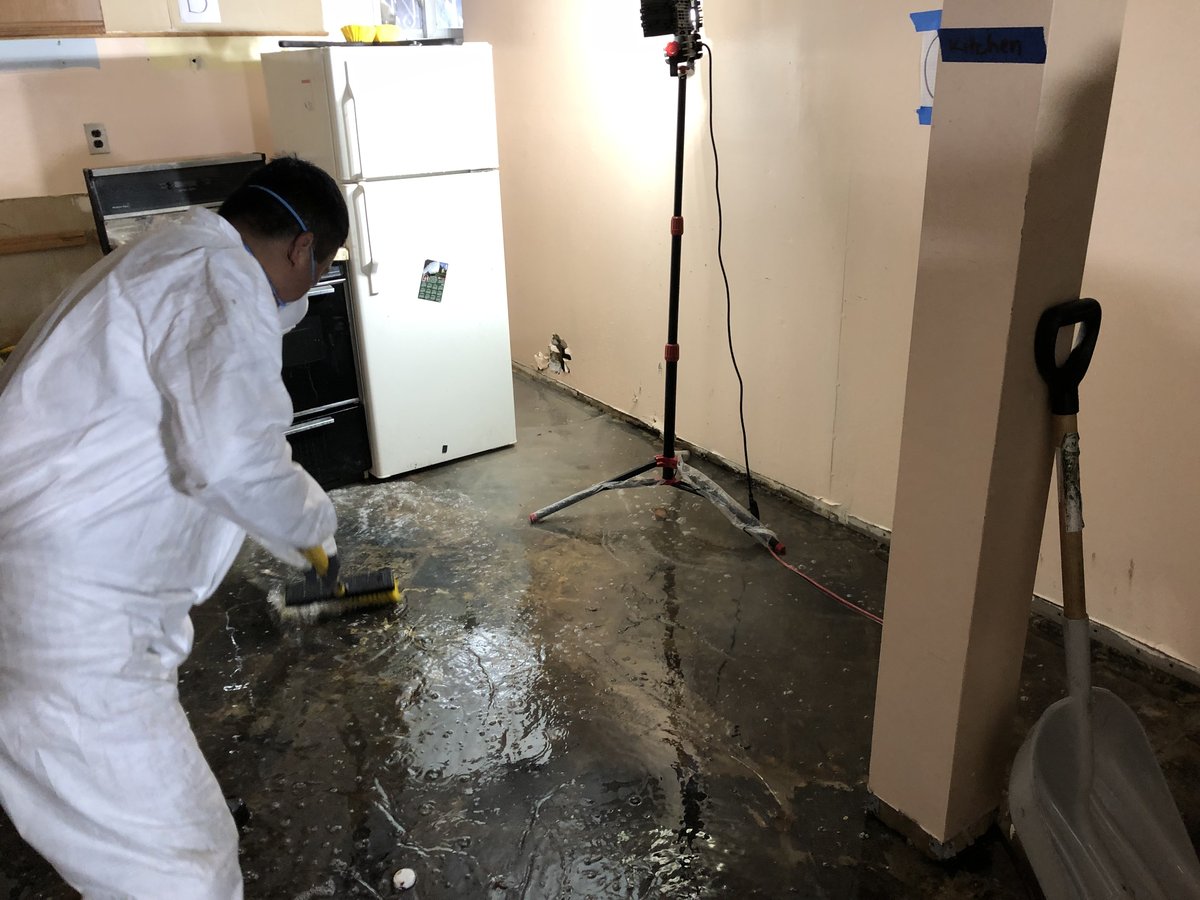
Mechanical agitation on the affected floor surface, Staten Island sewage cleanup, IICRC S500 protocol.
The current EPA disinfectant list architecture, as of May 2026, is as follows. List B covers tuberculocidal products effective against Mycobacterium tuberculosis, and is the OSHA-recognized class for blood and other potentially infectious materials. List G covers norovirus. List H covers methicillin-resistant Staphylococcus aureus and vancomycin-resistant enterococci. List K covers Clostridioides difficile spores. List S covers bloodborne pathogens including HIV-1, hepatitis B virus, and hepatitis C virus.
Older industry literature still references EPA Lists C, D, E, and F. EPA retired those four lists in 2018 and consolidated them into List S. Any vendor page or specification document that cites "EPA List E" as a current operative list is working from outdated reference material. A Cat 3 protocol that names List B, List G, and List S by current designation reads as current; one that names List C or List E reads as not.
Anajur selects EPA-registered disinfectants from List B as the primary class for residential and commercial sewage cleanup, with List G, List H, and List K products selected when the source profile or post-cleanup occupancy makes that addition meaningful. List S products are deployed when bloodborne pathogen contact is suspected. Every product carries an EPA registration number on its label; that number is verifiable through the EPA Pesticide Product Label System database. Application logs record the product name, EPA registration number, dilution ratio, contact time, and the surfaces treated.
Chemistry Family
Quaternary ammonium compounds
Broad-spectrum hospital disinfectants with relatively long dwell times in the 5 to 10 minute range. Inactivated by anionic detergent residues and by heavy organic load. Compatible with most non-porous hard surfaces. Common active ingredient on List B and List H labels.
Chemistry Family
Sodium hypochlorite (bleach)
Effective against most sewage pathogens at 1:10 household-bleach dilution, the level OSHA recognizes for blood and body-fluid cleanup. Bleach is not formally EPA-registered as a disinfectant unless the bottle carries an EPA registration number. Corrosive to metals and degrades fabrics; rapidly inactivated by organic load.
Chemistry Family
Accelerated hydrogen peroxide
Faster contact time, typically 1 to 5 minutes for hospital-disinfectant claim. Broader substrate compatibility than quats or bleach, gentler on finishes. Used in occupied-space and food-contact applications. Common on List B and List G labels.
Chemistry Family
Peracetic acid
Sporicidal, required when Clostridioides difficile contamination is suspected (List K). Aggressive on metals and elastomers; requires careful dilution and PPE during application. Used selectively rather than as a general-purpose Cat 3 disinfectant.
Clean before disinfect. Visible organic soil, fecal matter, biofilm, food debris, inactivates disinfectants by binding the active ingredient before it can reach the target microbe. Cleaning is the first pass, with an EPA-registered detergent or a labeled cleaner-disinfectant in its cleaning step. Disinfection is the second pass, on a visibly clean surface, at the labeled dilution, for the labeled contact time. Cutting either step short produces a surface that smells clean but isn't. Documentation records both passes, product names, dilutions, dwell times, and surface coverage, so that the file shows a defensible decontamination, not an assumption of one.
What Stays, What Goes, Why
The Cat 3 decision matrix for porous, semi-porous, and non-porous materials.
The IICRC S500 Standard divides building materials into three porosity classes for the purpose of Cat 3 decision-making. The rule is straightforward in the standard and gets compromised in the field for two reasons, pressure to reduce demolition cost, and the optical illusion that a surface looks clean after a wipe-down. Neither reason changes what S500 says. Porous materials wetted with Category 3 water are removed and disposed. Semi-porous materials may be cleaned, decontaminated, and dried back if structural integrity is intact. Non-porous materials are cleaned and disinfected.
Wetted carpet pad, paper-faced gypsum board, fiberglass batt insulation, mineral wool, cellulose, particleboard, MDF, upholstered furniture, and paper-backed wallcovering are removed and disposed as part of the Cat 3 protocol. The pore structure absorbs and harbors pathogens that surface application of disinfectant cannot reach. There is no surface treatment that defensibly remediates these materials after sewage exposure.
Unsealed concrete, exposed CMU, dimensional framing lumber, and plywood subfloor that received only short-duration contact and that retain structural integrity may be cleaned, decontaminated with an EPA List B product at labeled dwell time, and dried back to equilibrium moisture content with the reference areas. The standard requires verification, moisture readings, visual inspection, and where the source profile warrants, surface fecal-indicator sampling.
Sealed concrete, glazed ceramic tile, sheet metal, sealed hardwood flooring, glass, and finished plastics are cleaned and disinfected in place. The two-step protocol, cleaning pass followed by disinfection pass at registered contact time, is the same as for any non-porous surface in a contaminated environment. The cleaning step matters more here than on any other Cat 1 or Cat 2 work because organic load on sealed surfaces is the single most common cause of disinfection failure.
The decision matrix is where Cat 3 protocols come apart in practice. A vendor under fee pressure will leave wetted carpet pad in place because pulling it triggers more demo, more haul-out, more replacement carpet, and a larger final invoice the carrier may push back on. The standard does not bend for cost. A wetted pad in a Cat 3 environment is a biohazard substrate and must be removed. The argument the contractor makes to the adjuster is the standard itself.
For below-grade space, the rebuild after demolition has its own set of code requirements, paperless gypsum board for basement exterior walls, foam-insulation systems for subfloor assemblies, code paths for finished cellars and habitable basements. Our the basement cleanup breakdown covers the reconstruction-side detail in depth, including NYC Building Code Section 2506.3 mold-resistant gypsum, closed-cell spray foam below-grade applications, and NYC DOB Alteration Type 2 versus Type 1 thresholds for finished basement work. This page focuses on the demolition-side decision: what comes out, why it comes out, and how the decision is documented.
The Mechanical System Decision
Why some ductwork gets cleaned and some gets replaced.
HVAC contamination is the part of Cat 3 work that gets undersold most often. A sewage backup that affects an air handler, return-air pathway, or wetted ductwork carries the contamination through the building's air every time the system runs. Most vendor pages treat the question generically, "we clean the ductwork." The honest answer requires a distinction the National Air Duct Cleaners Association codified in its ACR (Assessment, Cleaning & Restoration of HVAC Systems) Standard: not all duct material is cleanable to a defensible end state. Three cases, three different verdicts:
Generally Cleanable
Supply-side metal ductwork
Sheet metal trunks and branches that received only aerosolized contamination. Source-removal cleaning, mechanical agitation, HEPA-filtered collection, and post-cleaning inspection produce a documented end state, the interior is non-porous, reachable, and verifiable by visual and surface sampling.
Replace, Don't Clean
Return-side ductwork wetted with sewage
Low-mounted return runs or basement returns where backed-up water reached the duct. Once raw sewage contacts the interior, contamination moves into joints, seams, and fasteners that mechanical cleaning cannot reliably reach. NADCA ACR calls for replacement. The same applies to the air handler interior, coil, plenum, blower housing, on documented contact.
Replace, Porous Lining
Lined fiberglass duct board
The lining is porous, and the standard treats porous interior surfaces wetted with Cat 3 water exactly as it treats porous building materials, they cannot be reliably decontaminated and must be replaced. Fiberglass-lined sheet metal falls here too if the lining absorbed contamination. The end state cannot be confirmed by visual inspection.
Anajur scopes the HVAC decision against the actual contamination pathway and coordinates with a NADCA-certified specialty subcontractor when the cleaning side of the work requires that credentialing. The carrier sees a single estimate with the HVAC scope inline rather than a separately-billed handoff that creates a documentation gap. The supply-versus-return distinction shows up in the line items because the standard requires it to.
Where The Debris Actually Goes
NYS DEC 6 NYCRR Part 364: and why most sewage debris is C&D, not regulated medical waste.
The waste-disposal side of a Cat 3 cleanup is where competitor pages either go silent or overstate. The regulatory framework, current as of May 2026, is published. 6 NYCRR Section 360.2 defines Regulated Medical Waste in New York as a specific set of categories, cultures and stocks of infectious agents, human pathological waste, blood and blood products, contaminated sharps, isolation waste, animal research waste, generated in a healthcare or research setting. Sewage-saturated drywall, carpet, and insulation from a residential or non-medical commercial backup do not meet that definition.
“Materials contaminated by raw or partially-treated sewage or septage” are regulated waste subject to NYSDEC transporter permitting.
6 NYCRR Part 364-1.2 (Waste Transporters)
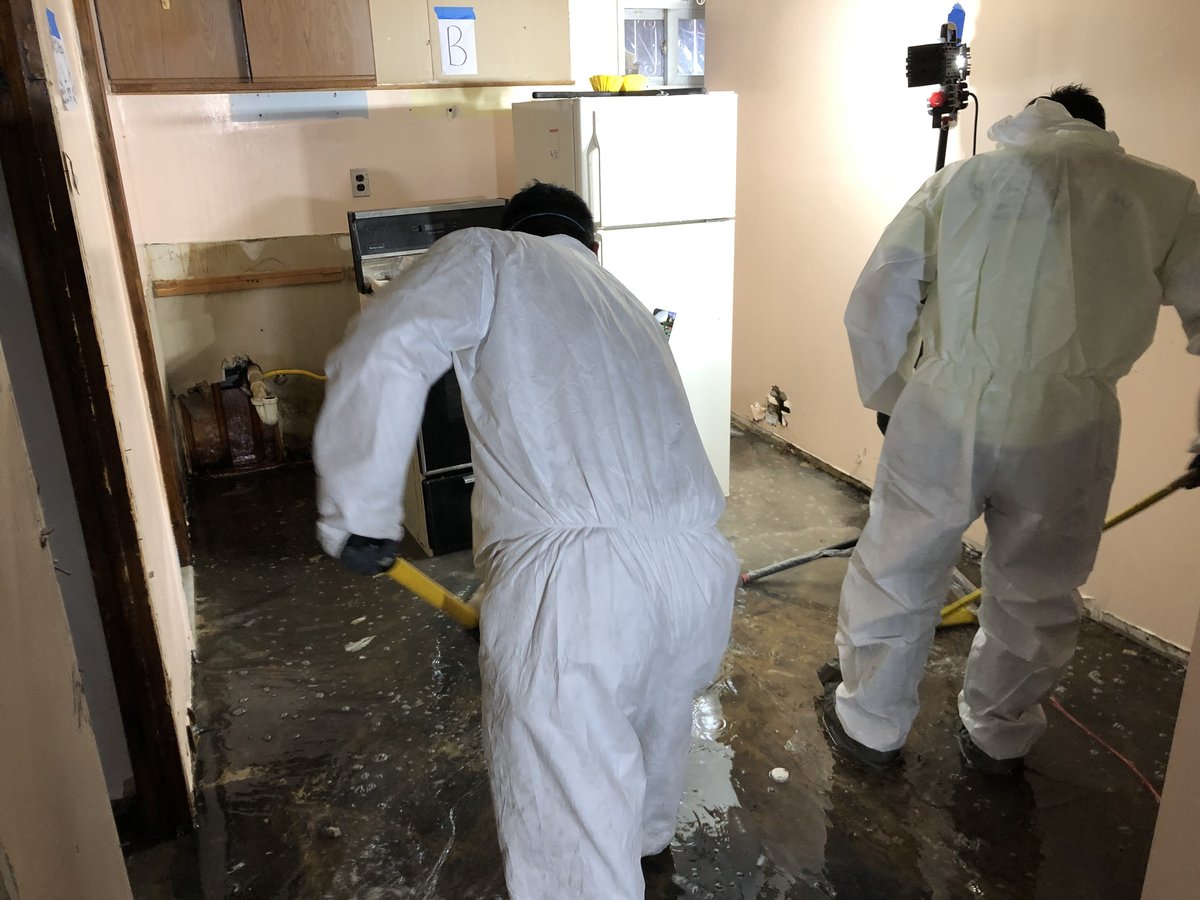
Documentation taping of affected work zones, chain-of-custody for Cat 3 wastestream on a Staten Island sewage cleanup.
The operative classification for sewage-saturated demolition debris from a typical residential or commercial Cat 3 remediation is industrial-commercial waste under 6 NYCRR Part 364, the NYSDEC Waste Transporter regulation, not regulated medical waste. The two paths lead to different facilities, and the disposal line item depends on which one the source profile actually triggers:
Default · Most sewage debris
Industrial-commercial waste (Part 364)
Sewage-contaminated drywall, carpet, fibrous insulation, and porous demolition material from a residential or non-medical commercial backup. Hauled by a Part 364–authorized transporter to a NYSDEC-permitted facility whose permit covers the stream, standard NYS-permitted C&D facilities qualify. Treating this as RMW inflates the disposal line item.
Escalated · Source-triggered
Regulated Medical Waste (Subpart 360-17)
Reclassification happens when the source changes the wastestream, sewage from a healthcare facility, sharps encountered during demolition, or visible blood-saturated material. The transporter must hold the RMW endorsement on its Part 364 permit under 6 NYCRR Subpart 360-17, and the receiving facility is one of a smaller set of permitted RMW destinations.
Part 364 also distinguishes transporter registration from transporter permit. Lower-risk streams may be hauled under registration; higher-risk streams, regulated medical waste, hazardous waste, sewage sludge and biosolids, raw sewage and septage, require a permit. The NYSDEC fee tier for residential septage and residential raw sewage is $250 for the first vehicle and $200 for each additional; the tier for other regulated waste, including non-residential sewage-contaminated material and RMW, is $500 for the first vehicle and $200 for each additional. These figures appear on the published Part 364 application schedule and are the same numbers a properly authorized transporter operates under.
Recordkeeping is non-optional. 6 NYCRR §364-5.1 governs waste tracking documentation; §364-5.2 covers transporter recordkeeping and reporting. Manifests, weight tickets, and receiving-facility acknowledgments form the chain of custody for the waste stream. When the same contractor handles demolition and reconstruction, that documentation joins the project file naturally; when two vendors split the job, the manifest from the demo subcontractor often does not reach the carrier on time. The page that tells every customer their sewage debris is RMW is not reading the rule; the page that says it can ride to any landfill is not reading it either. Anajur scopes the wastestream to the source.
How We Prove The Space Is Safe
Post-decontamination verification and habitability sign-off.
The cleanup is finished when the documentation says it is finished. A vendor who packs up after the visible work looks complete and bills the carrier without a verification step has done remediation; they have not produced a defensible clearance. The IICRC S500 framework treats verification as a separate phase of the work, not an optional add-on, and on Cat 3 sites the verification standard is higher than on Cat 1 or Cat 2 because the consequences of an undetected residual contaminant are health consequences rather than aesthetic ones. A sewage clearance typically combines four reads:
Read 01 · Necessary, not sufficient
Visual inspection
Confirms all porous materials flagged for removal are gone, retained semi-porous materials show no residual soiling, and non-porous surfaces are visibly clean before disinfection. The first read, but pathogens are not visible at infectious-dose concentrations, so it cannot stand alone.
Read 02 · Dry-back
Moisture verification
Confirms retained semi-porous materials are dried to equilibrium with the structure's reference areas. S500 treats wood substrates as dry at 16% moisture content or below, with affected materials equilibrating to the moisture profile of unaffected reference areas in the same building.
Read 03 · Cleaning efficacy
ATP bioluminescence sampling
A swab and luminometer measure adenosine triphosphate as a proxy for organic load. Not a direct pathogen count, it reads any biological residue, but a fast on-site benchmark. A baseline from an unaffected area sets the threshold; the cleaned area should match. A thirty-second answer to "did the cleaning step actually clean."
Read 04 · Lab clearance
Surface fecal-indicator sampling
Coliform and E. coli swab cultures sent to a lab for plate count, the read required in high-stakes occupancies (DOHMH food service, OCFS child care, Article 28 healthcare) and any dispute needing a third-party clearance affidavit. A CIH or qualified practitioner collects; results return in one to three business days as the documentary anchor.
The honest framing on quantitative clearance thresholds is that the industry does not operate under a single published number that resolves every site. The American Conference of Governmental Industrial Hygienists, in Bioaerosols: Assessment and Control, declines to set a fixed numeric TLV for non-infectious bioaerosols on the grounds that surface and air sampling for fecal-indicator organisms is interpretive against site-specific background and outdoor controls. Industry-typical practice on a sewage clearance is non-detect for fecal indicator organisms on cleaned surfaces relative to the building reference area. Anajur documents the sampling protocol, the lab method, the reference comparison, and the result. The carrier and the regulator see the actual data, not a marketing number.
Commercial Cat 3, The Closure-Window Playbook
Food service, daycare, medical, multi-unit: what triggers immediate closure and how to reopen fast.
Commercial Category 3 events are governed by a different regulatory layer than residential ones. The cleanup protocol is the same, the IICRC S500 standard does not change category by occupancy type, but the chain of authorities that can keep the establishment closed (and the documentation chain that gets it reopened) is more complex. Four occupancy types account for almost every commercial Cat 3 event Anajur encounters on Staten Island and across NYC:
NYC Health Code Article 81
Food service establishments
24 RCNY §81.03(y) defines an imminent health hazard; sewage backup sits squarely within it, and Chapter 23 places an inadequate sewage system at the highest condition level as a Public Health Hazard. §81.39(d) authorizes immediate permit suspension and cessation of operations.
18 NYCRR Subpart 418-1
Group day care centers
§418-1.3(n) requires safe water supply and sewage facilities at all times. A sewage event compromising that is a non-compliance condition; the program must consult its OCFS licensor on the path back to operation. The licensor's directive controls, and the file that supports a fast reopening is the same Cat 3 file.
NY PHL §2805-l · Article 28
Healthcare facilities
Hospitals, diagnostic and treatment centers, dialysis, ambulatory surgery, under 10 NYCRR §§405.8 and 751.10 and the NYPORTS framework. A sewage event affecting patient-care or clean-utility space is potentially reportable. OSHA's Bloodborne Pathogens Standard applies here in full, the healthcare source escalates the wastestream classification.
NYC Housing Maintenance Code
Multi-unit residential
§27-2026 places the duty to maintain plumbing and drainage on the owner. HPD typically classifies an active backup exposing habitable space to raw sewage as a Class C immediately hazardous violation with a 24-hour correction deadline; classification is at HPD's discretion on inspector findings.
Across all four, reinspection timing is rarely pinned to a fixed window, the regulators schedule return inspection at their discretion once the condition is abated. The lever the establishment controls is the abatement file at the moment of the reinspection request. Anajur builds that file as the work proceeds: IICRC S500 Cat 3 protocol log, photographs at each demolition and decontamination phase, EPA registration numbers and dwell-time records for every disinfectant applied, post-decontamination verification (ATP and surface fecal-indicator sampling where the source profile warrants), and Part 364 hauler manifests showing the wastestream chain of custody. When the inspector arrives, the file answers the questions before they are asked, and the owner with one contractor producing a continuous record has a stronger position than the owner who split cleanup and reconstruction across two vendors and produced a fragmented one.
Where Carriers Deny And How Documentation Wins
The seven-pattern denial taxonomy for sewage claims in New York.
Carrier denial patterns on sewage claims sort into seven categories. Each one has a documentation answer. The contractor who produces the documentation in real time, before the carrier raises the issue, closes the file faster than the contractor who responds to denials reactively:
Pattern 01
Endorsement never purchased
Standard HO-3 does not cover sewer backup. Coverage requires a water-backup endorsement the policyholder either bought or didn't. The dec page settles it.
Pattern 02
Endorsement limit exhausted
Endorsement limits typically run $5,000 to $25,000. Demolition and decontamination on a finished space can consume the limit before reconstruction begins, leaving the rebuild uncovered. Scope sequencing matters.
Pattern 03
Reclassification as flood
When the backup occurs during a heavy-rain event, the carrier may try to recharacterize the loss as flood, excluded under HO-3, and invoke an anti-concurrent-causation clause to deny the entire claim.
Pattern 04
Reclassification as gradual seepage
If the wastestream pattern looks like long-term plumbing failure rather than an acute event, the carrier may invoke the gradual-damage exclusion.
Pattern 05
Misrepresentation
Under NY Insurance Law §3105, a material false statement on the application, including unpermitted alterations or an undisclosed prior loss.
Pattern 06
Negligence / maintenance carve-out
Backup attributable to owner failure to maintain, grease-clog accumulation, root intrusion in a known compromised lateral, can be carved out under a maintenance-exclusion endorsement.
Pattern 07 · Most consequential
Internal plumbing vs. municipal sewer
The standard sewer-or-drain exclusion in many policies applies to backup from outside the property. Backup originating inside the property is covered under base policy terms. The origin point decides coverage.
The internal-versus-external distinction is settled in New York law. In Pichel v. Dryden Mutual Insurance Company, 117 A.D.3d 1267, 986 N.Y.S.2d 268 (3d Dept. 2014), the Appellate Division, Third Department, addressed a basement backup caused by a clogged interior plumbing line. The court held that water damage from a backup originating from a pipe or clogged drain located within the insured's property line comes from the insured's plumbing system and is covered under the base policy, while a backup whose cause is outside the property line, a clogged municipal sewer forcing water into the system, falls within the sewer-or-drain exclusion. The decision is on the published record at FindLaw caselaw. The practical implication is that the documented origin point of the backup is the dispositive fact in the coverage analysis.
Anajur's documentation chain is built for this exact dispute. Photographs and video at the source point, the cleanout location, and any externally-visible municipal infrastructure; plumber statements identifying internal versus lateral failure; moisture mapping that follows the water from origin to affected materials; and the continuous file that a single licensed contractor produces from extraction through reconstruction. 11 NYCRR 216 (Regulation 64) imposes timeline obligations on the carrier under NY Insurance Law §2601 (Unfair Claim Settlement Practices Act), and a complete file forces the carrier to those timelines. Our basement flooding page develops the endorsement-form analysis (ISO HO 04 95, HO 06 95) and the NY General Municipal Law §50-e ninety-day Notice of Claim deadline against municipal defendants in greater depth.
Why One Licensed HIC Wins The File
The structural argument for cleanup and reconstruction under one license.
The restoration industry's standard model splits a sewage event between two vendors. A mitigation company arrives in the first hours, performs extraction and demolition, applies an antimicrobial, drops drying equipment, and bills the carrier. A general contractor arrives weeks later to handle the rebuild. The two estimates are written separately, the two scopes overlap or leave gaps, the depreciation calculations don't reconcile, the warranty coverage splits at the demo-to-rebuild handoff, and the documentation chain has a discontinuity at the moment when a continuous record matters most, the moment between contamination removed and finished surface installed.
The Anajur Moat
One DCWP license covers both halves of the work, so there is no handoff to dispute.
Anajur Construction Corp. is licensed to do mitigation and reconstruction under one credential. NYC DCWP Home Improvement Contractor License #1220350-DCA covers the reconstruction scope, framing, drywall, flooring, mechanical, finish, that follows the demolition; the IICRC S500 protocol governs the mitigation scope. Both run under the same project manager, the same Xactimate file, the same chain-of-custody for waste manifests and disinfectant logs, the same insurance documentation, and the same warranty.
A vendor who only does mitigation cannot offer that. A general contractor who lacks the Cat 3 protocol cannot offer it. A national chain that subcontracts both halves to local labor pools does not run a single file across them. The combination, one DCWP-licensed family-owned construction company, in continuous operation on Staten Island since 1997, with the IICRC-compliant Cat 3 protocol and the documentation discipline that makes the carrier's job easier rather than harder, is the case Anajur makes for itself.
If sewage has entered occupied space on Staten Island, the next call is the one that decides which file the carrier reads.
Deeper reading on Cat 3 water and biohazard claim documentation.
Long-form articles on the IICRC S500 standard, mitigation timing, and the insurance documentation that survives carrier review on Category 3 black water claims.
Category 1, 2, and 3 classifications under ANSI/IICRC S500-2021, the standard that defines sewage as Category 3 black water and dictates the salvageability framework adjusters apply.
Photo timestamps, moisture readings, source identification, and the protocol that protects the insurance claim before mitigation starts. Applies equally to sewage backups and clean-water events.
How a Cat 3 sewage loss becomes a defensible claim: the contamination-category argument, the regulated-disposal line items, and the documentation chain that separates an approved scope from a denied one. Same workflow applies to sewage backup claims.
What Staten Island homeowners and operators ask about sewage cleanup.
No. Sewage backup that originates from inside your property line is generally covered under a water-backup endorsement on a homeowners or commercial property policy. Flood damage from external surface water is excluded from standard property policies and requires a separate NFIP flood policy. The distinction is dispositive in coverage analysis and is settled in NY case law.
Sewer-backup coverage is added to a standard policy through an endorsement such as ISO HO 04 95 (homeowners) or HO 06 95 (broadened version effective March 2022). Flood coverage is a separate NFIP policy with its own deductible and coverage architecture. Carriers sometimes attempt to recharacterize a heavy-rain sewage backup as flood and invoke an anti-concurrent-causation clause to deny the entire loss. The NY Third Department's decision in Pichel v. Dryden Mutual establishes the internal-versus-external test that controls. Our our basement water guide develops the endorsement form-number analysis in greater depth.
Generally no, for ordinary residential and commercial sewage events. OSHA's July 30, 2007 PRASA interpretation letter states that the Bloodborne Pathogens Standard at 29 CFR 1910.1030 does not generally apply to wastewater work in the absence of visible blood, healthcare-source contamination, or sharps in the wastestream.
For ordinary sewage cleanup, the operative framework is the OSH Act General Duty Clause at Section 5(a)(1) combined with PPE general at 1910.132, respiratory protection at 1910.134, and workplace sanitation at 1910.141. The Bloodborne Pathogens Standard is fully triggered when the event has a healthcare-facility source, free-flowing or dried blood is present, or sharps are encountered. In those scenarios the contractor's obligations expand to a written Exposure Control Plan, hepatitis B vaccination at no cost within ten working days, and annual training. The PRASA interpretation is documented at osha.gov.
Generally no for porous materials. The IICRC S500 standard treats wetted carpet pad, paper-faced gypsum drywall, fiberglass batt insulation, and other porous materials in a Category 3 environment as removed and disposed. Non-porous and semi-porous materials may be cleaned, decontaminated, and dried back if structural integrity is intact.
The pore structure of carpet pad, paper-faced drywall, and fibrous insulation absorbs and harbors pathogens that surface application of disinfectant cannot reach. There is no surface treatment that defensibly remediates these materials after sewage exposure. Semi-porous materials such as unsealed concrete, framing lumber, and plywood subfloor that received only short-duration contact and retain structural integrity may be cleaned and dried. Non-porous surfaces, sealed concrete, glazed tile, metal, sealed hardwood, are cleaned and disinfected in place. Our below-grade flooding resource covers below-grade reconstruction including paperless drywall and code-compliant rebuild paths.
EPA-registered List B tuberculocidal disinfectants are the OSHA-recognized class for blood and other potentially infectious materials and are the primary product class for sewage cleanup. List G covers norovirus, List H covers MRSA and VRE, List K covers C. difficile spores, and List S covers bloodborne pathogens. Product selection follows the source profile.
EPA retired Lists C, D, E, and F in 2018 and consolidated them into List S. Any vendor specification that cites "List E" as a current operative list is working from outdated reference material. Bleach at 1:10 dilution is OSHA-recognized for blood and body-fluid cleanup but is not formally EPA-registered as a disinfectant unless its label carries an EPA registration number; bleach is also corrosive and rapidly inactivated by organic load. Anajur cleans before disinfecting, organic soil binds active ingredients before they reach the target microbe, and documents product name, EPA registration number, dilution, and dwell time for every application.
Within 24 to 48 hours of source containment. The IICRC S500 standard treats this window as the threshold before which secondary microbial growth on wetted materials accelerates significantly. Beyond 48 hours, additional building materials cross from semi-porous-salvageable into porous-by-saturation and must be removed.
The 24-to-48-hour window is the operational rule the standard uses to set salvageability decisions. Wood framing that retains structural integrity and is cleaned and dried within 48 hours typically remains in place. The same framing under prolonged saturation can develop visible mycelial growth and require IICRC S520 mold remediation protocol on top of the S500 sewage protocol, mold remediation is a separate IICRC S520 specialist scope that Anajur does not perform; we coordinate a specialist for that phase before reconstruction begins, doubling overall project scope and cost. Acting fast is the single largest cost-control lever the property owner has after the source is contained. Anajur dispatches Cat 3 crews from Staten Island and operates 24/7/365 because that window is the binding constraint.
Abatement of the imminent health hazard and reinspection by DOHMH. Sewage backup affecting a food service establishment is a Public Health Hazard under 24 RCNY §81.03(y), and §81.39(d) authorizes immediate permit suspension. Reinspection is scheduled at the Department's discretion once the establishment requests return inspection with abatement documentation.
The Health Code does not pin reinspection to a fixed twenty-four-hour window, scheduling is at the Department's discretion. The practical lever the establishment has is the abatement file at the moment of the reinspection request: IICRC S500 Cat 3 protocol log, photos at each phase, EPA registration numbers and dwell-time records for every disinfectant applied, post-decontamination verification (ATP and surface fecal-indicator sampling), and Part 364 hauler manifests showing wastestream chain of custody. Anajur builds that file as the work proceeds so the inspector sees a complete record on arrival.
For a typical residential or non-medical commercial sewage cleanup, the debris is industrial-commercial waste under 6 NYCRR Part 364, not regulated medical waste. A Part 364–authorized transporter hauls it to a NYSDEC-permitted facility whose own permit covers that waste stream. Standard NYS-permitted C&D facilities can accept this material.
Regulated medical waste under 6 NYCRR Part 360.2 is reserved for healthcare-source waste, blood-saturated materials, and sharps. A residential basement remediation does not produce RMW. Reclassification escalates the wastestream when the source is a healthcare facility, when free-flowing or dried blood is present, or when sharps are encountered, at which point the transporter must hold the RMW endorsement on its Part 364 permit and the receiving facility must be one of the smaller set of NYSDEC-permitted RMW destinations under Subpart 360-17. Manifests under §364-5.1 and §364-5.2 form the chain of custody.
Continuity. One Xactimate file, one chain-of-custody, one warranty point, one depreciation calculation, and one project manager across both halves of the work. The standard mitigation-plus-rebuild handoff between two vendors creates a documentation discontinuity at the exact phase boundary where carriers most often dispute scope and cost.
The two-vendor model produces overlapping or gap-leaving scopes, separate Xactimate files that don't reconcile cleanly, separate depreciation calculations, and warranty splits at the demolition-to-rebuild handoff. When a carrier disputes a line item or asks where the demolition record connects to the reconstruction scope, that gap is what the dispute lands on. Anajur's NYC DCWP HIC #1220350-DCA covers reconstruction; the IICRC S500 protocol governs mitigation; both run under the same project file. The file the carrier reads has no internal handoff to dispute.
One contractor. One license. One call.
Category 3 black water containment, IICRC S500 demolition and decontamination, post-clearance verification, and the permitted rebuild on Staten Island, all under NYC DCWP HIC License #1220350-DCA.