Emergency Response · Staten Island
NYC DCWP HIC #1220350-DCA Family-Owned Since 1997
Water Damage Reconstruction · Staten Island

Reconstruction & Repairs After Water Damage on Staten Island One contractor from cleanup to rebuild since 1997.

Direct answer Most water damage jobs end with a homeowner holding two phone numbers: one for the company that cleaned up the water, and a separate contractor to handle the reconstruction. Anajur Construction Corp. is a NYC DCWP-licensed Home Improvement Contractor (HIC #1220350-DCA) that handles water damage mitigation through final-coat reconstruction under a single license. Family-owned and operated in Staten Island since 1997.

Reconstruction is the rebuild phase that follows water damage mitigation, replacing drywall, insulation, flooring, subfloor, cabinetry, framing, baseboards, and paint that cannot be saved. The cleanup phase is performed under ANSI/IICRC S500-2021. The rebuild phase is performed under a NYC Department of Buildings ALT-2 permit when scope requires, with all work itemized to NY Xactimate line items.

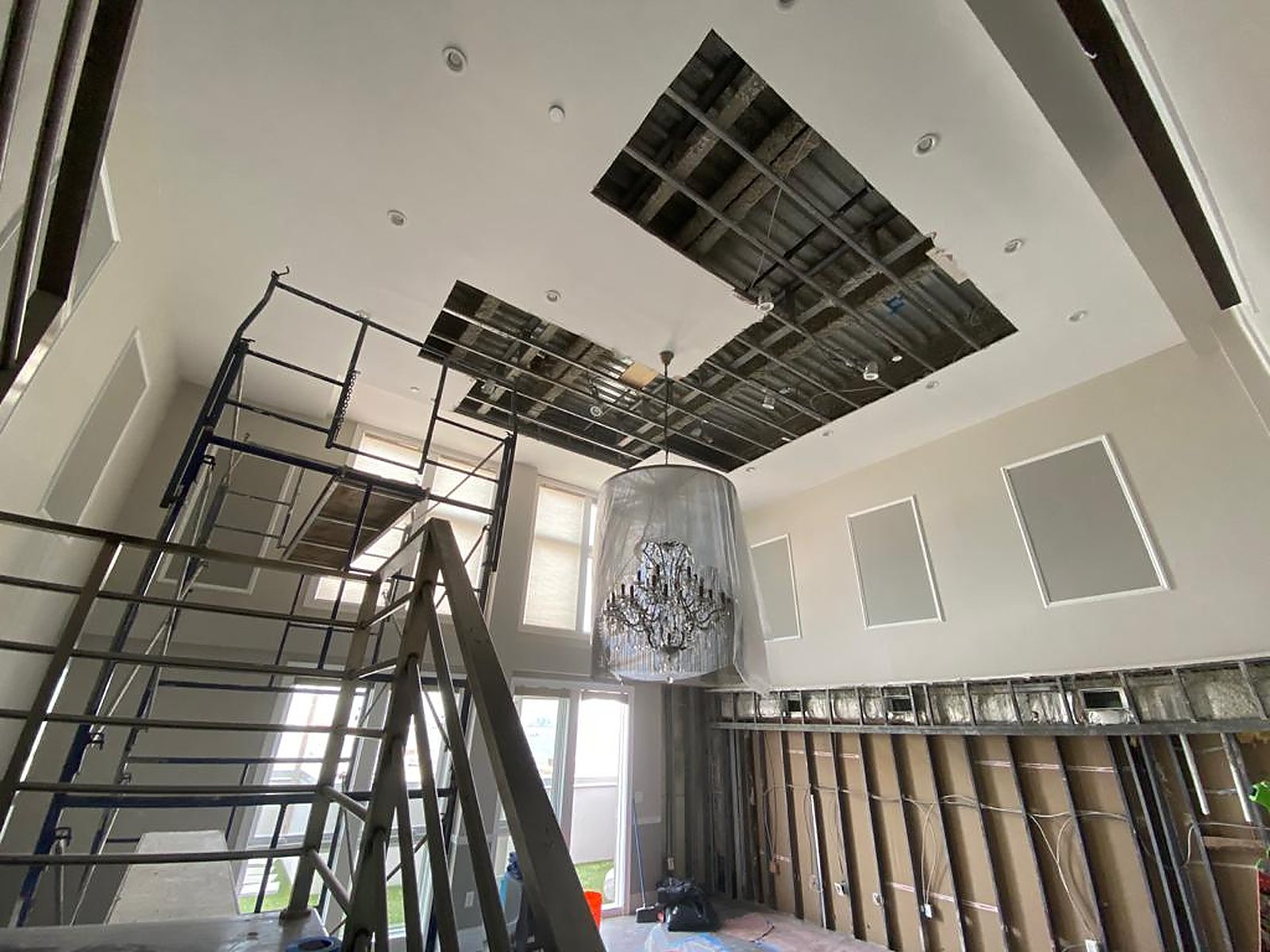
Anajur Construction reconstruction on Staten Island, ceiling drywall removed, wall framing exposed after roof leak.
In-progress reconstruction: ceiling drywall removal and wall framing repairs after a roof leak in Staten Island.
By Jouri, founder of Anajur Construction Corp. · NYC DCWP HIC #1220350-DCA · Family-owned on Staten Island since 1997 · Last updated June 11, 2026 · Water Damage Restoration · Sewage Cleanup · Basement Flooding · Flood Cleanup
1997
Established
On Staten Island
1
License
Mitigation to Rebuild
$200
Threshold
When NYC HIC Required
ALT-2
Permit
DOB NOW: Build
The Rebuild Phase

What reconstruction means after the water is gone: and why most homeowners are unprepared for it.

Water damage work splits cleanly into two phases. The first phase is mitigation: extraction, structural drying, dehumidification, antimicrobial treatment, and the controlled removal of materials that cannot be saved. Mitigation runs to the ANSI/IICRC S500-2021 standard. It typically takes three to seven days and is usually performed by a restoration company. When the moisture meters read dry, that phase ends.

What's left is a structure with the wet materials removed. Drywall cut to the flood line. Subfloor exposed where the carpet pad came up. Framing visible where insulation was pulled. The mitigation crew packs out, the dryers leave, and the homeowner is standing in a partially demolished house holding a final mitigation invoice and a blank slate where the rebuild needs to start.

That blank slate is reconstruction. It is the phase that puts drywall back on studs, flooring back on subfloor, cabinetry back in the kitchen, paint on the walls, baseboards on the floor, and trim on the windows. In New York City, residential improvement work beyond the statutory licensing threshold requires a Home Improvement Contractor licensed by the NYC Department of Consumer and Worker Protection. Reconstruction almost always exceeds that threshold.

Most national restoration franchises stop at the end of the mitigation phase. Their license, their insurance, their crew composition, and their corporate model are all built for the dry-out side. The rebuild is handed to a separate general contractor, sometimes one the franchise refers to, sometimes one the homeowner has to find. That is where projects most often go wrong: scope arguments at the handoff, schedule gaps while the rebuild contractor mobilizes, and double mobilization fees that nobody warned the homeowner about.

Anajur is a Home Improvement Contractor first. The license under which we rebuild your home is the same license under which we coordinate the mitigation. One company, one project manager, one signature on the contract, one accountable contractor for the entire job from extraction through the final coat of paint.

The Two-Phone-Numbers Problem

Do you need two contractors after water damage? Why most homeowners end up holding two phone numbers.

Direct answer Not necessarily. In New York City, a licensed Home Improvement Contractor can perform both water damage mitigation and the reconstruction that follows, drywall, flooring, cabinetry, and structural repairs, under one license. Most national restoration franchises subcontract the rebuild phase. A NYC DCWP-licensed HIC like Anajur Construction Corp. handles both phases directly.

The two-contractor pattern is not an accident of the restoration industry, it is how the industry is structured. Restoration franchises are trained, equipped, certified, and insured for the cleanup phase. Their crews carry IICRC certifications for the mitigation work. Their equipment inventories are extraction trucks, dehumidifiers, air movers, and antimicrobial treatment. Their relationships with insurance carriers are around the mitigation scope.

Reconstruction is a different business with different licensing. In New York City it requires the DCWP Home Improvement Contractor license, which has its own application, exam, surety bond, insurance requirements, and renewal cycle. Most restoration franchises don't hold an HIC in the names of their local franchisees, because reconstruction is not their commercial focus. When the dry-out finishes, they refer the rebuild to whoever has the license, sometimes a corporate-affiliated GC, more often the homeowner's problem to solve.

The handoff is where the costs live that nobody warns homeowners about. Scope arguments at the boundary: did the mitigation crew remove enough drywall, or does the GC have to cut more before framing repairs can begin? Schedule gaps while the new contractor walks the site, scopes the work, and writes an estimate, weeks the family is out of the house. Double mobilization: two pull-up-to-the-curb fees, two dumpster orders, two sets of port-a-johns, two punch lists. Insurance supplements that get filed and sometimes denied because the carrier's adjuster scoped the mitigation phase against one set of line items and the reconstruction phase against another.

Anajur is a NYC DCWP-licensed Home Improvement Contractor whose principal trade is construction. Reconstruction has been the company’s main work from its first year. The mitigation we perform is in service of the rebuild we are about to do, not in service of a separate company's line item. There is no handoff because there are no two companies. The same project manager scopes the dry-out, watches the moisture meters, and writes the rebuild estimate. The same crew can be on the job for both phases when scope and timing allow it. The contract the homeowner signs covers the work end to end.

That is the dual-scope claim, accurately stated. Anajur is not the only company in New York City that can do both phases. We are a family-owned Staten Island Home Improvement Contractor, operating under one unbroken DCWP license across twenty-nine years, who built the company around the rebuild phase rather than treating it as something that happens after we leave.
Scope of Work

What Anajur's reconstruction scope covers: drywall, flooring, framing, finish carpentry, and the trades we coordinate.

Reconstruction after water damage covers a defined set of building systems and finishes. The scope below is what Anajur self-performs or coordinates under our HIC license on a typical residential reconstruction project on Staten Island. Each line is itemized on the Xactimate or fixed-bid estimate so the homeowner sees exactly what's included before any work starts.

Self-Performed

Drywall & Insulation

Drywall removal and replacement is the single largest line item on most reconstruction projects. Anajur self-performs full-room drywall replacement, partial wall sections, and ceiling work. Insulation is replaced where wet, with attention to fire-rated assemblies in attached structures.

Self-Performed

Subfloor & Finish Flooring

Subfloor delamination after water damage is common and not always visible until the finish floor comes up. Anajur replaces wet subfloor, installs underlayment, and lays the finish flooring, hardwood, engineered hardwood, luxury vinyl plank, ceramic tile, or carpet.

Self-Performed

Framing & Structural

Wet studs, joists, and headers are replaced sister-by-sister or full-member depending on the moisture-content reading at demolition. Load-bearing repairs are filed with NYC DOB under ALT-2 with Registered Architect or Professional Engineer plans when scope requires.

Self-Performed

Cabinetry & Finish Carpentry

Kitchen and bathroom cabinetry replacement, baseboards, casing, crown, doors, and door hardware. Custom cabinetry and specialty millwork are sourced and installed with timeline-aware sequencing so finishes don't wait on slow lead times.

Self-Performed

Paint & Wall Finishes

Interior paint, primer-and-paint on new drywall, wallpaper removal where required, and texture-matched repairs. Color matching to existing untouched rooms is part of the scope when the loss is partial.

Coordinated

Trade-Licensed Work

Electrical reroute, panel work, and any wiring under code authority is performed by a NYC-licensed Master Electrician under our project management. Plumbing reroute, fixture replacement, and any work under plumbing code is performed by a NYC-licensed Master Plumber. HIC license holders are not permitted to perform these scopes directly; coordinating them is part of our work.

What's not in this scope: Anajur does not perform fire damage restoration, smoke remediation, or mold remediation. Those are different trades with different certifications. If a project also requires those scopes, we coordinate the homeowner with a specialist for that phase before our reconstruction work begins. See scope discipline below.

For projects involving sewage cleanup, see our sewage cleanup page; for basement-specific water events, see basement flooding; for storm and flood-driven losses, see flood cleanup. Each of those pillars covers the mitigation scope; this page covers what comes after.

Insurance Coordination

Reconstruction estimates and your insurance carrier: Xactimate scope, supplemental claims, and what gets approved.

Most reconstruction work after water damage is paid through homeowners insurance. The carrier issues an initial scope estimate based on the mitigation report, then a supplemental scope when the rebuild details are confirmed. Anajur prices the reconstruction phase to Xactimate New York zone line items, the same software adjusters use to scope and audit claims, so the carrier's estimate and our estimate speak the same language.

What We Document

Daily Photo Log & Moisture Map

Every drying day, every wet material removal, every framing condition. Photos timestamped and geotagged to the project address. The moisture map at demolition is the document that justifies what got cut versus what stayed. The carrier's adjuster receives the full log when the supplemental is filed.

Xactimate Scope

Line-Item Itemization

Every drywall sheet, every linear foot of baseboard, every cabinet box, every square foot of paint, all priced to Xactimate New York zone. No lump-sum reconstruction packages. The line items the carrier sees match the line items the homeowner sees match the line items the crew is working from.

Supplemental Claims

The Rebuild Phase Is Almost Always Supplemented

Most carriers issue a first check that funds the mitigation and the visible reconstruction at the time of inspection. Hidden conditions discovered at demolition, wet subfloor under tile, mold-pre-cursor moisture in a wall cavity, framing damage behind drywall, trigger supplemental filings. Anajur files supplements with photo and moisture-meter evidence so they're approved instead of denied.

Recoverable Depreciation

ACV vs. RCV Explained Simply

The carrier's first check is usually Actual Cash Value, the depreciated value of what was damaged. The remainder, called recoverable depreciation, is released after we submit completed-work invoices. We document completion in a way the carrier accepts the first time so the second check arrives without a fight.

For losses involving the mortgage holder, typically claim checks above ten to twenty-five thousand dollars depending on the lender, Anajur coordinates with the lender's loss-draft department so funds are released against work milestones the lender accepts. We don't name carriers as preferred providers and we don't accept referral fees from carriers. The work and the documentation are what the carriers approve, not relationships.

Floods are different Standard homeowners policies cover sudden internal water damage (burst pipes, appliance failures, roof leaks during covered storms). External flooding from rising water requires a separate NFIP flood policy. If your loss is flood-driven, see our flood cleanup page for how the NFIP claim process differs from a standard homeowners claim.
Credentials & License

NYC DCWP-licensed Home Improvement Contractor: credentials, license, and what they actually mean.

The single document that authorizes a contractor to legally perform residential reconstruction in New York City is the Home Improvement Contractor license issued by the NYC Department of Consumer and Worker Protection. Per NYC Administrative Code §§20-386 and 20-387, anyone performing residential home improvement work over two hundred dollars in New York City is required to hold this license. Local Law 21 of 1968 created the licensing scheme, codified today at Administrative Code §§20-385 through 20-402. On Department of Buildings permit applications for home improvement work to one- to four-family homes, the HIC license is required, and ours appears on every qualifying filing we make.

NYC DCWP HIC License
#1220350-DCA
Active and verifiable at a866-dcwpbp.nyc.gov
NYS DOS Entity
#2160072
Active New York corporation since 1997

The license requires more than passing an exam. NYC DCWP requires every HIC to maintain a twenty-thousand-dollar surety bond (or Trust Fund enrollment), workers' compensation coverage, and EPA Renovation, Repair, and Painting certification. The principal of the company personally passes a Home Improvement business law exam. The license carries the legal liability for the work performed under it. When the homeowner's contract is signed with a NYC DCWP-licensed HIC, the license itself is the homeowner's recourse if something is done wrong.

Anajur has held HIC #1220350-DCA continuously since the company was founded in 1997. The license number on this page, on every contract, on every permit, and on every estimate is the same number. The verification link goes to the actual NYC DCWP business portal where the license status, expiration, and bond status are public record. If a homeowner wants to verify before signing, the verification takes less than a minute.

A Home Improvement Contractor license does not authorize a contractor to perform plumbing, electrical, fire suppression, or other trade-licensed work. Those scopes require separate NYC Department of Buildings licenses (Master Plumber, Master Electrician, etc.). Anajur coordinates trade-licensed subcontractors under our HIC project management; we do not perform their scopes directly. That separation is statutory and we honor it.

NYC Permits & Code

Do you need a permit to repair water damage in NYC? ALT-1, ALT-2, ALT-3, and what triggers each.

Direct answer In New York City, repairs after water damage cleanup must be performed by a NYC DCWP-licensed Home Improvement Contractor once the work crosses the licensing threshold. Some restoration companies hold this license and rebuild in-house; many subcontract the rebuild to an outside general contractor. Verify the HIC license number before signing any reconstruction contract.

NYC Department of Buildings permits for residential alterations come in three filing types. Knowing which one a reconstruction project requires is part of scoping the work honestly, permits add weeks to the timeline and have their own fees and inspection requirements that need to land in the estimate.

ALT-1

Changes Certificate of Occupancy

Rare for water damage rebuilds. ALT-1 covers projects that change the building's certificate of occupancy, converting a single-family home to a two-family, adding a story, that scale of change. Most water damage reconstruction does not trigger ALT-1.

ALT-2

Substantial Structural / MEP Work

The most common permit type for significant water damage reconstruction. Triggered when work touches plumbing, electrical, or structural systems, or when drywall replacement exceeds a certain area on load-bearing or fire-rated assemblies. Filed through DOB NOW: Build with Registered Architect or Professional Engineer plans. Permit issuance typically takes four to eight weeks.

ALT-3

Single-Trade Minor Scope

Limited applicability to reconstruction work. ALT-3 covers like-for-like single-trade replacement that doesn't change the building's structural or mechanical systems. Some small-scope reconstructions qualify; most do not.

Exempt Work

Minor Alterations & Ordinary Repairs

Per NYC Administrative Code §28-105.4.2, minor alterations and ordinary repairs are permit-exempt, like-for-like replacement with the same or equivalent materials (paint, flooring, cosmetic drywall patching) that does not affect health, fire-rated assemblies, or structural elements. The specific exempt categories are enumerated in 1 RCNY §101-14. Anajur confirms exempt-status in writing on the estimate so there's no ambiguity.

When an ALT-2 is required, Anajur files directly through DOB NOW: Build under HIC #1220350-DCA. We coordinate the Registered Architect or Professional Engineer for the stamped plans. We schedule the inspections. Permit fees and filing costs are line items on the estimate, not surprise add-ons. For homes in co-op or condominium buildings, we also coordinate the building's board approval process, which can run parallel to or sequential to the DOB filing depending on the building's bylaws.

The permit timeline is real and it shapes the project schedule. A whole-floor reconstruction that needs an ALT-2 will run forty-five to seventy days of permit-clearance time before the rebuild starts in earnest. That isn't lost time, cabinetry, flooring, and finish materials are sourced during the permit window so when the permit clears the work begins immediately. Telling the homeowner this upfront is part of how the project stays on schedule.

Pricing

What reconstruction costs in New York: pricing factors, Xactimate methodology, insurance vs. cash-pay.

Reconstruction pricing varies more than mitigation pricing, because reconstruction scope varies more. A single-room rebuild with builder-grade finishes and a whole-floor reconstruction with custom cabinetry and code-required electrical upgrades sit at opposite ends of a wide range. Honest ranges and the factors that move pricing within them are below; specific quotes come after a scope walk.

Tier 1, Mitigation (the dry-out phase)
$4.50 to $9.50 per square foot, for typical Class 1 to Class 2 water events.
Typical 200 to 800 square foot basement event: $1,800 to $5,500.
Source basis: NY Xactimate WTREXT line items + Class 2/Cat 2 multipliers; Angi NYC market data with NYC pricing premium.
Tier 2, Reconstruction (the rebuild phase)
$20,000 to $60,000, single-room or multi-room reconstruction with standard finishes.
$60,000 to $150,000+, whole-floor or multi-room reconstruction with custom cabinetry, code upgrades, or specialty flooring.
$25 to $60 per square foot, full reconstruction including drywall, insulation, flooring, paint, electrical reroute, and cabinetry.
Source basis: NY Xactimate reconstruction line items; NYC market multiplier (~25-30% above national); typical insurance-supplemented project ranges.

Why reconstruction estimates vary so widely

Anajur prices reconstruction using NY Xactimate when the work is insurance-covered, and fixed-bid quotes when it isn't. Every estimate is itemized, no lump-sum "reconstruction package" pricing. The homeowner sees every line item, every unit price, and every quantity. The carrier's adjuster sees the same document. There are no hidden numbers in either direction.

Service Area

Reconstruction across all thirteen Staten Island ZIP codes: neighborhoods we serve.

Anajur reconstruction services cover all of Staten Island, including the North Shore (10301, 10302, 10303, 10310), Mid-Island (10314), East Shore (10304, 10305, 10306), South Shore (10307, 10308, 10309, 10312), and West Shore (10311). Reconstruction inquiries from the South Shore and East Shore tend to concentrate around storm-driven flooding events and aging-housing-stock plumbing failures; North Shore inquiries are typically condo or row-house water-line failures requiring careful coordination with co-op or condo boards.

The borough's reconstruction patterns are shaped by what the borough is built of. The pre-war housing stock on the North Shore, St. George, New Brighton, West Brighton, Port Richmond, was built with cast-iron drain stacks and copper supply lines that are now sixty to ninety years old. Failures are common; reconstruction often surfaces additional plumbing issues during the rebuild that need to be addressed at the same time. The South Shore's post-1960s development stock has different failure modes, appliance supply lines, washing machine hoses, dishwasher connections, with reconstruction scope that's usually room-confined.

Anajur is staffed and equipped for any of the thirteen ZIPs. The crew is borough-based, not dispatched from across the harbor. For homeowners outside Staten Island who landed on this page: we don't currently take reconstruction projects outside the borough. The license, the crew, the project management, and the relationship density we maintain are Staten Island-focused.

About the Founder

About Jouri: Staten Island construction since 1997, and why we kept the rebuild in-house.

"I started Anajur in 1997 because I wanted to build the way I'd want my own home built. Decades later, the same family runs the same shop, and I still walk every reconstruction project myself. The reason we do both phases, the cleanup-side coordination and the rebuild, under one Home Improvement Contractor license is simpler than people make it. Most water-damage jobs end with a homeowner standing in a dried-out room, holding two phone numbers: one for the company that cleaned up, and one to find for the rebuild. We just kept the rebuild in-house. One license, one team, one signature on the contract."

, Jouri, Founder

Anajur Construction Corp. has operated under NYC DCWP HIC #1220350-DCA continuously since 1997. The company is family-owned. The principal is the same person who started it. The crew has worked together long enough that handoffs between trades inside our project management run on relationships, not paperwork. That continuity is what lets us scope a rebuild accurately the first time and stay on schedule through the trades that come behind us.

"I've been rebuilding Staten Island homes since 1997, which means I was here in October 2012 when Sandy hit the East and South Shore. I don't market on it. I mention it because the homes I worked on then are part of why I still do this work today."

Project Examples

Three Staten Island reconstruction projects: anonymized scope, timeline, outcome.

Project examples below are based on real Anajur Construction reconstruction projects on Staten Island. To protect homeowner privacy, we describe each project at the borough/shore level only, no addresses, no names, no insurance carrier identification. Each homeowner has signed a written release authorizing this use under New York Civil Rights Law §§50–51. Project scope, timeline, and approximate value ranges reflect the actual work performed.

Project 1 · South Shore Staten Island

Frozen pipe burst, January

Mitigation: 4-day extraction and structural drying.
Reconstruction: Drywall replacement across two rooms, baseboard replacement, hardwood floor refinishing on partial-affected planks, paint touch-up to match adjacent untouched rooms.
Timeline: 3 weeks total reconstruction.
Outcome: Resolved through homeowner's carrier with one supplemental claim filed for hidden subfloor moisture discovered at demolition.

Project 2 · East Shore Staten Island

Storm-driven flood backup

Mitigation: Performed by a separate restoration company; Anajur engaged for reconstruction only.
Reconstruction: Whole-floor rebuild, drywall, insulation, flooring, cabinetry, electrical reroute coordination. ALT-2 permit filed with NYC DOB.
Timeline: 10 weeks total (approximately 8 weeks construction + 2 weeks permit clearance).
Outcome: Insurance covered with supplemental approved at final invoicing; homeowner displaced approximately 6 weeks via Additional Living Expenses (ALE) coverage.

Project 3 · Mid-Island Staten Island

Dishwasher supply line failure

Mitigation: 2-day extraction (Anajur both phases).
Reconstruction: Single-room kitchen reconstruction, cabinetry replacement, flooring (engineered hardwood), drywall on lower wall sections, paint, baseboards.
Timeline: 2.5 weeks total.
Outcome: Cash-pay (under homeowner's insurance deductible); fixed-bid quote with itemized scope.

Additional project examples available on request, with signed releases. We can typically share more case studies relevant to a specific homeowner's situation during the scope-walk conversation.

Scope Discipline

What Anajur doesn't do: scope discipline, and where to go for fire damage or mold remediation.

Anajur is a construction-first general contractor. We rebuild after water damage, drywall, flooring, cabinetry, paint, finish carpentry, framing, repairs. Fire restoration is its own specialist scope: the fire restoration specialist completes mitigation first, and Anajur handles the reconstruction phase after. If a job tests positive for mold, that is a separate IICRC S520 specialist scope. Anajur does not perform mold remediation; we coordinate a qualified remediation specialist and sequence the rebuild around that phase.

Saying clearly what's outside our scope is part of the work. The wrong contractor on a fire damage scope or a mold remediation scope is a worse outcome than the right specialist plus a separate reconstruction phase. If a project requires those scopes, we'll talk through the sequencing and timing during the scope walk so the rebuild starts only after the prior phase is done correctly.

The Process

How water damage reconstruction works on Staten Island: five phases, day by day.

Water damage reconstruction in Staten Island typically follows five phases: (1) mitigation by a restoration specialist (Days 1–7), (2) Anajur's scope review and Xactimate estimate (Days 7–14), (3) ALT-2 permit filing with NYC DOB if required (4–8 weeks), (4) reconstruction including framing, drywall, flooring, and finish carpentry (2–10 weeks depending on scope), and (5) inspection sign-off and warranty documentation.

Water Damage Reconstruction Process, Five Phases Diagram showing five phases of water damage reconstruction in Staten Island: Mitigation (Days 1-7), Scope and Estimate (Days 7-14), Permits if ALT-2 required (Days 14-42), Reconstruction (Days 14-70), and Sign-off and Warranty (Day 70+). 1 Mitigation Days 1–7 Water extraction, drying, demolition. Restoration company, often not Anajur. 2 Scope & Estimate Days 7–14 Mitigation report review, Xactimate. Anajur 3 Permits Days 14–42 (if ALT-2) DOB NOW: Build filing, RA/PE plans. Anajur · HIC #1220350-DCA 4 Reconstruction Days 14–70 Framing, drywall, flooring, finish. Anajur 5 Sign-off & Warranty Day 70+ DOB inspection, walkthrough, warranty docs. Water Damage Reconstruction · 5 Phases · Staten Island Anajur Construction Corp · NYC DCWP HIC #1220350-DCA Performed by mitigation specialist (often not Anajur) Performed or coordinated by Anajur Construction Corp Conditional phase (only if ALT-2 permit required)
Five-phase water damage reconstruction process, Staten Island, NY. Anajur handles phases 2 through 5 directly under one HIC license.
  1. 1

    Mitigation · Days 1–7

    Water extraction, structural drying, dehumidification, antimicrobial treatment, and demolition of unsalvageable materials. Performed per ANSI/IICRC S500-2021 standard. Often by a separate restoration company; Anajur if engaged for both phases.

  2. 2

    Scope & Estimate · Days 7–14

    Anajur reviews the mitigation report, walks the site post-dry-out, scopes reconstruction line-by-line, files the Xactimate estimate (or fixed-bid quote), and coordinates with the carrier's adjuster for scope alignment.

  3. 3

    Permits · Days 14–42 (if ALT-2 required)

    DOB NOW: Build filing under HIC #1220350-DCA. Registered Architect or Professional Engineer plans where required. Co-op or condo board approval coordinated in parallel. Typical ALT-2 permit issuance: four to eight weeks.

  4. 4

    Reconstruction · Days 14–70

    Framing repairs, drywall, insulation, subfloor, finish flooring, cabinetry, paint, finish carpentry. Trade-licensed scopes (electrical reroute, plumbing reroute) coordinated under our HIC project management.

  5. 5

    Sign-off & Warranty · Day 70+

    DOB inspection where permit-required. Final walkthrough with homeowner. Warranty documentation. Final invoice and recoverable depreciation submission to the carrier.

Further Reading

Deeper reading on water damage reconstruction in Staten Island.

Long-form articles on the documentation, standards, and insurance workflow that connect the mitigation phase to the rebuild phase, written from the chair that prices the rebuild.

Frequently Asked Questions

What Staten Island homeowners ask about water damage reconstruction.

Restoration is the mitigation phase, water extraction, drying, dehumidification, and removal of unsalvageable materials, performed to ANSI/IICRC S500-2021 standard, usually by a restoration company. Reconstruction is the rebuild phase that follows, installing new drywall, flooring, cabinetry, paint, and finish carpentry, work that requires a NYC DCWP-licensed Home Improvement Contractor in New York City.
Not necessarily. In New York City, a licensed Home Improvement Contractor can perform both water damage mitigation and the reconstruction that follows, drywall, flooring, cabinetry, and structural repairs, under one license. Most national restoration franchises subcontract the rebuild phase. A NYC DCWP-licensed HIC like Anajur Construction Corp. handles both phases directly.
Usually yes, when the underlying water damage is a covered loss under your homeowners policy (sudden burst pipes, appliance failures). Insurance typically pays for both mitigation and reconstruction using NY Xactimate pricing. Floods from outside the home are different, those need NFIP flood coverage. Anajur works directly with adjusters and itemizes scope to Xactimate line items.
Most single-room reconstructions take 2–4 weeks once permits clear and materials are on site. Multi-room or whole-floor reconstructions run 4–10 weeks. NYC ALT-2 permits add 4–8 weeks of pre-construction time when filing is required. Custom cabinetry or specialty flooring lead times can extend the timeline; we sequence work to minimize how long your home is unfinished.
Cosmetic, like-for-like repairs (paint, carpet replacement, minor drywall patching) generally don't require a NYC DOB permit, as minor alterations or ordinary repairs. Larger structural drywall work, anything touching plumbing, electrical, or structural elements, and any work on load-bearing or fire-rated assemblies require an ALT-2 filing. Anajur files permits directly through DOB NOW: Build using HIC #1220350-DCA. Per NYC Admin Code §28-105.4.2.
Not always, and that's the question this whole pillar exists to answer. Many homeowners use a restoration company for mitigation, then need a separate Home Improvement Contractor for the rebuild because most restoration franchises focus on the cleanup phase. Anajur is built for the rebuild side. We coordinate with the mitigation crew so the rebuild starts cleanly.
Drywall removal and replacement, insulation, framing repairs, subfloor and finish flooring, baseboard and trim, interior paint, kitchen and bathroom cabinetry, finish carpentry, electrical reroute coordination with licensed electricians, plumbing reroute coordination with licensed plumbers, and ALT-2 permit filing when required. Fire and mold remediation sit outside this scope, each with its own specialist.
Single-room rebuilds sit in the middle tier of the ranges published above, and whole-floor work runs multiples of that; the tier table on this page is the canonical set. The itemized scope walk is where your number gets real, because Category, Class, finish level, and code triggers move an estimate more than square footage does. Insurance scopes price to NY Xactimate line items; cash-pay work gets a fixed bid against the same scope methodology. Every Anajur estimate is itemized, never a lump-sum package.
No problem, Anajur regularly handles reconstruction after another company's mitigation work. We review the mitigation report, verify drying logs, and pick up the rebuild from where the dry-out ends. The transition matters: bring us in before final demolition decisions are made and we'll coordinate scope with the mitigation crew to prevent rework.
Schedule a Scope Walk

Schedule a reconstruction scope walk: an itemized estimate from a licensed contractor.

A scope walk is the on-site or photo-and-video review where we look at what the mitigation phase removed, what's left to rebuild, and what your insurance carrier has approved so far. We'll write you an itemized estimate priced to NY Xactimate (insurance) or fixed-bid (cash-pay), with permit and timeline expectations called out clearly.

We'll follow up to schedule your scope walk and write an itemized estimate. If your situation is urgent and standing water is still active, please call directly.

Call Anajur · Staten Island (917) 969-1378