NWFA moisture science, IICRC S500 drying standard, Xactimate-compatible scope, one licensed contractor from wet-floor diagnosis through sand-and-refinish.
Water-damaged hardwood can often be saved — if it is dried correctly and fast. Whether a floor is dried in place, sanded flat, or partially replaced depends on the wood, the water category, and how long it sat. Anajur is a NYC DCWP-licensed general contractor (#1220350-DCA) running insurance-track hardwood water-damage repair across all 13 Staten Island ZIP codes — moisture mapping to NWFA and IICRC S500 standards, in-place drying to the 6–9% target, and the sand-or-replace decision under one license. Xactimate-fluent estimator on the mitigation and the reconstruction. One file, one phone call — Jouri direct at (917) 969-1378.
The shape a wet hardwood floor takes is a diagnostic readout, not just cosmetic damage. Cupping, crowning, and buckling each tell you where the moisture is and how far the wood has already moved — and that is the first thing that decides whether the floor can be saved.
Cupping is the most common pattern: the edges of each board rise higher than the center, leaving a concave surface. It happens when the underside of the board holds more moisture than the top, so the bottom swells more — which usually means the water is coming from below, through the subfloor, or that a spill soaked in and is drying from the top down. The National Wood Flooring Association (NWFA) documents this mechanism in its problem-prevention guidance.
Crowning is the inverse — the center sits higher than the edges. It has two causes, and the second is the expensive one: either the top of the board got wetter than the bottom, or someone sanded a still-cupped floor flat, so when the wood finally dried the edges dropped below the crowned center. This is why sanding order matters, and it is documented by both the USDA Forest Products Laboratory and moisture-meter specialists such as Wagner Meters.
Buckling is the extreme: boards lift clean off the subfloor, sometimes by inches. It is the reaction to flooding or prolonged submersion, where the expansion force of saturated wood overcomes the fasteners or adhesive holding it down. Cracking and checking — splits along or across the grain — come from repeated shrink-and-swell cycles and the dimensional stress described in Chapter 4 of the USDA FPL Wood Handbook.
Read together, the distortion is a moisture map: cupping points to moisture below, crowning to moisture above (or premature sanding), and buckling to catastrophic saturation. Whether any of it reverses comes down to one thing — how long the wood stayed wet. Minor-to-moderate cupping in solid wood commonly re-flattens over several weeks to a few months once the moisture source is gone and the room stabilizes, sometimes only after a full heating-and-cooling cycle. But wood that sat saturated long enough takes a compression set: the swelling boards, restrained on every side, crush their own cell structure, and once those cells are crushed they will not spring back — the cupping is permanent no matter how perfectly the floor is dried afterward. Anajur reads that pattern, takes moisture readings, and decides — rather than defaulting to “rip it out.” Diagnosis comes before demolition.
Wood is hygroscopic — it constantly trades moisture with the air around it. Two numbers govern everything that happens to a wet floor: the fiber saturation point and the equilibrium moisture content. Get those right and you know whether a floor can be dried back flat.
The fiber saturation point (FSP) sits at roughly 28–30% moisture content for most North American species. Per the USDA Forest Products Laboratory Wood Handbook (GTR-282, Chapter 4), wood’s volume “does not change at moisture content values above approximately 30%.” Below that point, the only water present is bound inside the cell walls, and the wood moves dimensionally with every change in moisture. Above it, any added water is free water sitting in the cell cavities — it does not cause further swelling. That is the whole reason a wet floor cups: as moisture climbs from a normal 6–9% toward fiber saturation, the boards expand, and restrained by their neighbors and fasteners, they have nowhere to go but up at the edges.
The second number is the target. Wood equilibrates to the temperature and humidity around it — its equilibrium moisture content (EMC). Per the NWFA technical publication “Water and Wood,” citing the USDA FPL handbook, hardwood flooring is manufactured at 6–9% moisture content, a band that coincides with the 30–50% relative-humidity, 60–80°F range a house normally lives in (at 70°F and 40% RH, the EMC is about 7.7%). That 6–9% band — and being within about two percentage points of the subfloor — is the readiness target a floor must reach before anyone sands it.
The practical implication is the part homeowners rarely hear: drying is not finished when the floor “looks dry.” It is finished when a moisture meter reads 6–9% consistently across the whole area. That single distinction — readings, not appearances — is the difference between a floor that is genuinely saved and one that crowns or re-cups months after it was refinished.
Not everything called “hardwood” survives water the same way. The construction of the floor often decides repair-versus-replace before timing or water category even enter the conversation.
Solid hardwood — a single ¾-inch piece of wood — swells as a unit, cups, and can be dried and sanded flat. It carries the highest salvage rate of any floor type; a solid floor caught fast is usually saveable. Engineered flooring is the opposite risk: a thin real-wood veneer bonded over a plywood or HDF core. Water attacks the adhesive layers and causes delamination, which is irreversible, and veneers thinner than 2 mm cannot be sanded at all once damaged. Engineered flooring with delamination or a sub-2 mm wear layer generally routes straight to replacement.
Laminate is not wood at all where it counts — a fiber or HDF core under a photographic wear layer. It absorbs and swells fast, and once swollen it is generally not salvageable. Floating floors, which are not fastened to the subfloor, are more prone to lift and separate, and the assembly plus underlayment tends to trap moisture beneath where it is hard to dry.
Then there is the layer nobody sees. If the moisture stayed in the boards, only the boards need attention; if it reached the subfloor, the floor has to come up so the subfloor can be dried or replaced. Plywood and OSB can both delaminate, and OSB is the more moisture-sensitive of the two — when OSB is replaced, it generally has to be set slightly thicker than the plywood it stands in for to match height and stiffness. Older Staten Island homes often sit on solid board subfloors rather than sheet goods at all, which dry differently and telegraph moisture into the finish floor in their own way. A soft or rotting subfloor cannot be cleaned — it is removed. This is exactly where the single-license model earns its keep: the same contractor who identifies the floor type pulls the boards, dries or replaces the subfloor, and rebuilds, with no handoff in the middle. For the installation, board replacement, and refinish execution itself, our flooring crew handles the sanding and matching.
The repair-or-replace decision comes down to four variables — floor type, water category, how long it sat, and whether the moisture reached the subfloor. Together they sort every wet floor onto a ladder, from dry-in-place at the cheap end to full replacement at the expensive one.
In-place drying saves the floor when the water was Category 1, it was caught within roughly 24–48 hours, the floor is solid wood, and the subfloor is sound. Professional drying brings the wood back toward the 6–9% target, and minor cupping in a solid floor commonly re-flattens on its own over several weeks to a few months — no sanding required.
Sanding and refinishing fixes residual cupping only after the floor has reached confirmed, stable, normal moisture content, cupping is mild-to-moderate, and enough wear layer remains. Sanding too early ruins the floor: cutting the raised edges of a still-cupped board leaves them thin, and when the board finally dries flat, the center stands proud as permanent crowning. The safe order is moisture control, then stable readings, then sand. A ¾-inch solid floor can be sanded roughly four to seven times over its life — about 1/32″ per pass — and every prior refinish spends down that budget.
Board-level replacement is the call when localized boards are buckled, cracked, or still read elevated after extended drying: pull them and weave in matching boards, then refinish to blend. Full replacement takes over when more than roughly 30% of the area is damaged, the subfloor is soft or delaminating or moldy, Category 3 (black) water was involved, mold has established beneath the floor, the floor has already hit its refinish limit, or the repair cost approaches the cost of replacement.
Two overrides cut across all of this. The floor-type override: delaminated or sub-2 mm engineered flooring and swollen laminate route to replacement regardless of how fast they were caught. The water-category gate under ANSI/IICRC S500: Category 1 (clean) water is often dried and salvaged; Category 2 (gray) requires disinfection and more removal; Category 3 (black — sewage or flood water) directs that porous materials be removed, so hardwood exposed to it is generally not salvageable. And step zero is always the source: if a burst supply line was behind it, or water came down through the ceiling from above, that has to be stopped before any drying decision holds.
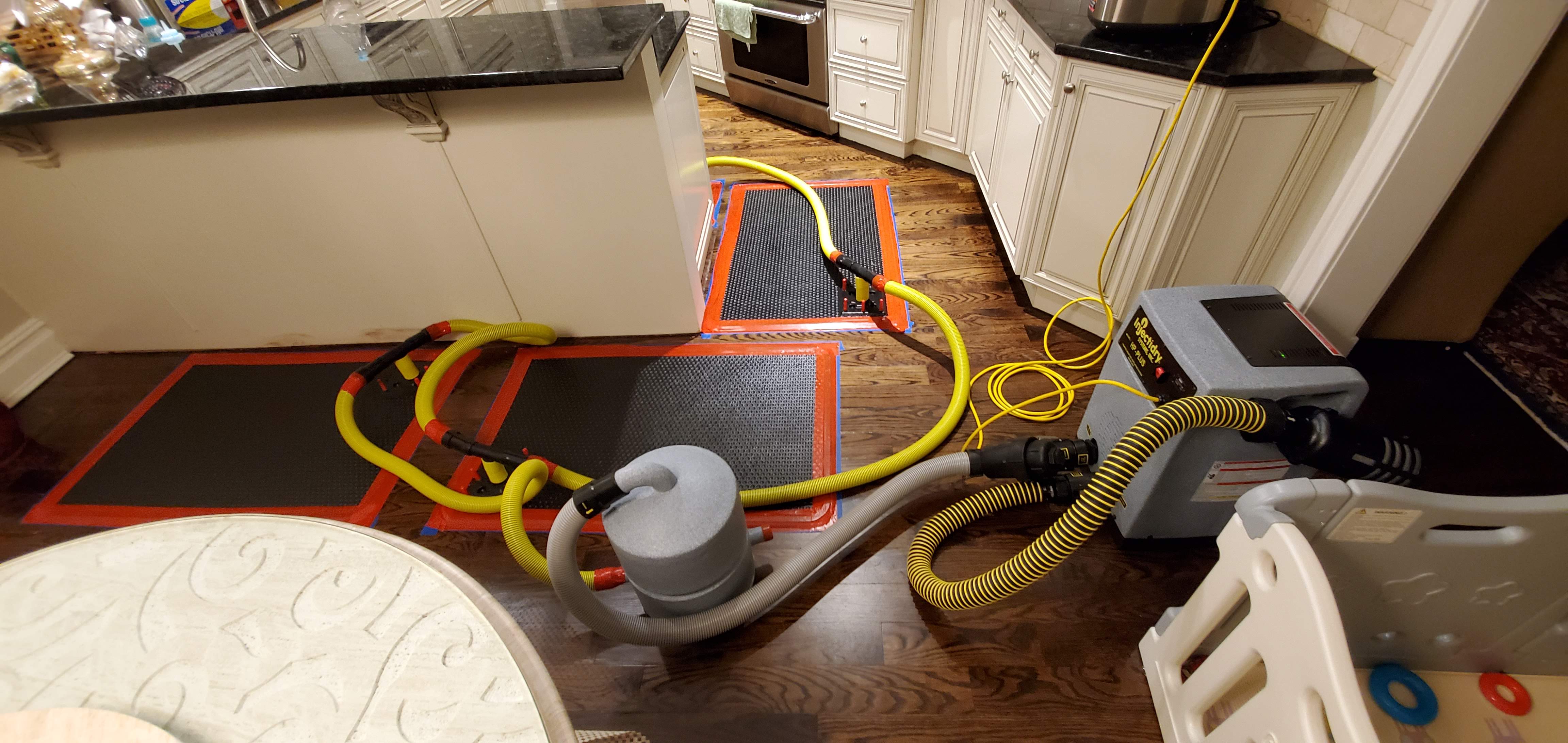
Professional drying is a measured process, not just fans pointed at the floor. The goal is to pull the wood back to a documented 6–9% moisture content slowly enough that it does not split, then make the sand-or-replace call on hard readings instead of guesses.
It starts by stopping the source — if the floor keeps re-wetting, the wood never stabilizes and the carrier rejects the scope. Standing water is extracted, airflow is established, and then the equipment goes in: air movers and commercial dehumidifiers, and on stubborn floors a specialized floor-drying system — mats sealed to the surface that pull moisture up through the boards under negative pressure, drying the assembly from within instead of waiting for it to migrate out on its own. That equipment runs in days, not hours, and the duration is itself a billable line, so it is monitored the whole time rather than left running blind.
Drying is deliberately gradual. Rapid drying splits wood, because the surface dries and shrinks faster than the core; controlled drying brings the whole board down together. Moisture readings are logged daily across the area and compared against the subfloor — the target is not just 6–9% in the boards but the boards landing within a couple of percentage points of the subfloor beneath them, because a finish floor drying faster than what it sits on will simply re-absorb moisture from below. Drying continues until those readings hold steady. Only then does the decision get made — minor cupping is left to re-flatten or refinished, residual cupping at stable moisture is sanded and refinished, failed boards are woven out and replaced, and a compromised subfloor is pulled and rebuilt.
A word on mold, because it comes up on every wet floor. Drying to the 24–48 hour window is itself the primary mold-prevention step: per US EPA mold guidance, materials dried within 24–48 hours of a leak will, in most cases, not grow mold. If mold has already established beneath a floor, that is a separate specialist remediation scope governed by the IICRC S520 standard and referred out — Anajur dries and rebuilds the floor; it does not position itself as a mold-removal service. Everything else runs as one file under license #1220350-DCA, from first response through the final coat of finish. When the damage runs past the floor into framing or adjacent rooms, it becomes a full reconstruction scope — still one contractor, still one file.
Most hardwood water-damage claims turn on a single distinction: sudden and accidental versus gradual. A burst pipe or an appliance overflow is generally covered; a slow leak that went unaddressed generally is not.
On the covered side sit the sudden-and-accidental events — a burst pipe, an appliance or HVAC discharge, a sudden supply-line failure, wind-driven rain through a sudden opening, ice-dam seepage. The Insurance Information Institute (III) frames these as “water from the top down,” generally covered under standard New York HO-3 and HO-5 homeowners policies. On the excluded side sit continuous or repeated seepage over time, ordinary wear and tear, neglect and deferred maintenance, sewer backup (which needs a separate endorsement), and flood. Flooding is III’s “water from the bottom up” — it is covered only by separate National Flood Insurance Program (NFIP) coverage, not the homeowners policy. Adjusters tell the two apart using moisture readings, damage patterns, and repair history, which is precisely why day-one documentation decides so many files.
The scoping itself runs through Xactimate, the estimating platform adjusters and contractors share, which prices regionally by line item — labor, materials, and equipment, plus overhead and profit when more than one trade is involved, which a dry-strip-and-rebuild floor almost always is. A hardwood water-damage scope draws on water-remediation (WTR) line items and floor-covering-wood (FCW) categories. The WTR side carries the mitigation: water extraction, air movers and dehumidifiers billed as equipment days, antimicrobial application where the category calls for it, and content manipulation or blocking to get furniture off the wet floor. The FCW side carries the repair: floor and subfloor removal, sand-and-finish, and like-for-like board replacement, each valued at replacement cost (RCV) versus actual cash value (ACV). A licensed contractor documents the moisture readings and photographs that justify every line. Anajur scopes the mitigation and the reconstruction on one file, written so the adjuster can read it — the page makes no promise about any specific claim outcome, only that the scope is documented and defensible.
There is no flat price for a water-damaged floor. Cost is a function of where the floor lands on the dry → sand → board-replace → full-replace ladder, and the single biggest lever is how fast the water was addressed.
Seven drivers move the number. Area size — the square footage actually affected. Decision tier — dry-only costs less than sand-and-refinish, which costs less than partial board replacement, which costs less than full replacement with subfloor; every rung up adds labor, materials, and time. Floor type — solid wood is salvageable and sandable, while engineered and laminate often mean full replacement. Subfloor condition — sound, versus needing drying, versus needing removal and replacement. Water category — a Category 1 floor is dried and restored, while Category 2 and 3 add removal, disinfection, and disposal. Finish matching — blending new boards and matching stain and sheen on an aged floor sometimes forces a whole-room refinish for uniformity. And equipment days — the longer the drying period, the more equipment time is billed.
The honest framing is the ladder itself: the further down it a floor falls, the higher the cost — and response speed is the lever that keeps a floor near the cheap end (dried in place) instead of the expensive end (full replacement plus subfloor). Real Staten Island job figures: reserved for verified ranges from completed Anajur projects — published per-square-foot benchmarks vary widely by source and framing, so this page does not quote a number it cannot stand behind. Call for a documented, line-item estimate on your floor.
Staten Island’s housing stock is older than most of the city’s, and the era a home was built in changes how its floors respond to water — and what it takes to repair them legally.
Per NeighborhoodScout, drawing on American Community Survey and U.S. Census data, 17.83% of Staten Island housing predates 1939 and another 26.40% was built between 1940 and 1969. Those are precisely the eras of solid-strip and parquet oak laid over board or early-plywood subfloors. The borough’s oldest concentration, in the pre-war North Shore homes around St. George and New Brighton, frequently retains original old-growth solid strip oak — often already sanded several times, so the remaining wear layer is thin and the dry-versus-sand decision is genuinely tighter, with less room left to cut.
That age carries a federal trigger. Disturbing finishes in a pre-1978 home brings the EPA Renovation, Repair and Painting (RRP) Rule into play: codified at 40 CFR Part 745, Subpart E, it requires EPA firm certification and lead-safe work practices when renovation disturbs lead-based paint in pre-1978 target housing. Per 40 CFR §745.83, the minor-work exemption applies only below six square feet of disturbed painted surface per interior room — and sanding old floor coatings in a pre-1978 Staten Island home can cross that threshold. Mid-century stock from the 1940s through the 1960s commonly carries parquet and narrow strip oak, sometimes over plank subfloors that pre-date modern plywood, which changes how subfloor moisture telegraphs up into cupping.
On permits: floor refinishing and resurfacing is generally a minor alteration or ordinary repair under NYC Administrative Code §28-105.4.2, which is exempt from a DOB permit — but a NYC DCWP Home Improvement Contractor license is still required, and a co-op or condo board may need to sign off. Anajur holds that license, #1220350-DCA, NY DOS entity #2160072, and has worked Staten Island’s pre-war and mid-century housing since 1997.
The same four variables — floor type, water category, dwell time, and whether the moisture reached the subfloor — sort almost every Staten Island hardwood loss into one of three patterns. These are framed as loss types, not specific job files; the salvage odds, the scope, and the carrier conversation change with each.
Pattern. A clean-water supply-line drip — sink, toilet, icemaker, washing-machine fill line — reaches a solid oak floor and is found inside the 24–48 hour window, with the subfloor still sound. The boards show edge-cupping, no buckling.
Triage. Category 1 under IICRC S500 — in-place drying with air movers and commercial dehumidifiers, monitored to a metered 6–9% moisture content. Minor cupping is left to re-flatten over weeks; sanding happens only if residual cupping remains once readings are stable. This is the highest-salvage case.
Insurance. Sudden and accidental, so generally a covered peril under a NY HO-3 policy. The scope — WTR extraction, equipment days, and any FCW sand-and-finish — is written to Xactimate at replacement cost. The lever is speed: this floor sits at the cheap end of the ladder precisely because it was caught fast.
Pattern. A dishwasher or washing-machine overflow — gray water — reaches an engineered or laminate floor and sits past 48 hours. The veneer or laminate core swells, and the adhesive bond begins to fail.
Triage. Category 2 — disinfection and removal of the affected porous material. Engineered delamination is irreversible and a sub-2 mm veneer cannot be sanded, so the floor routes to replacement regardless of how fast it was caught; the subfloor is checked and, if wet, pulled and dried or replaced. Here the floor’s construction, not the homeowner’s hopes, sets the outcome.
Insurance. Still sudden and accidental if the overflow itself was sudden, but the gray-water category drives more removal and disposal line items, and the FCW replacement is valued like-for-like at RCV versus ACV.
Pattern. Moisture from below — a slab or crawlspace source, or a loss that sat for days — saturates the subfloor and the underside of solid boards. A compression set takes hold and the cupping will not reverse; contamination may push the water to Category 2 or 3, and mold may have started beneath the floor.
Triage. Full replacement of the floor, and often the subfloor with it. If mold has established, that is a separate IICRC S520 specialist scope, referred out — Anajur removes and rebuilds the floor to standard. Past the salvage window the question stops being “can we dry it” and becomes “rebuild it right, once.”
Insurance. The sudden-versus-gradual line is sharpest here. A gradual below-grade seep is typically excluded; a sudden event that simply went undiscovered is argued on documentation — which is why day-one moisture readings and source photographs decide these files.
No national flooring-repair page has any reason to track these. These are the patterns Anajur sees on Staten Island floor calls — the field realities that change the diagnosis and the scope.
The surface dries first, so a homeowner — or a generalist working by eye — calls a floor done while the core is still well above the 6–9% target. Refinish it then and it re-cups or crowns weeks later. Anajur dries to a metered reading taken across the area and against the subfloor, never to appearance.
St. George and New Brighton sit in the borough’s oldest housing belt — 17.83% of Staten Island housing predates 1939 (NeighborhoodScout, ACS/Census). Those homes often keep their original old-growth strip oak, already sanded several times, so there may be only one refinish left and the dry-versus-sand decision is far tighter than on a modern floor.
Sanding old floor coatings in pre-1978 housing can disturb lead-based paint above the six-square-foot interior threshold in 40 CFR §745.83, which triggers the EPA Renovation, Repair and Painting Rule — firm certification and lead-safe work practices. A crew that sands first and checks later creates a federal compliance problem on Staten Island’s older stock.
The 1940–1969 stock — 26.40% of the borough (NeighborhoodScout) — often carries narrow strip or parquet oak over board subfloors that pre-date modern plywood. Subfloor moisture surfaces as cupping in patterns that do not match a plywood-subfloor assumption, which changes where the floor has to come up.
Floor refinishing is a permit-exempt minor alteration under NYC Administrative Code §28-105.4.2, but it still requires a NYC DCWP Home Improvement Contractor license. Anajur — HIC #1220350-DCA, NY DOS #2160072 — carries the mitigation and the reconstruction on one file, so there is no flooring-sub handoff and no gap where recoverable depreciation tends to break.
The pages that rank for hardwood water damage each own a piece — and none of them fuse the four things that actually decide a Staten Island floor claim.
The home-services publishers and national franchises cover the repair steps and the repair-or-replace question; the moisture-meter specialists go deep on cupping and crowning mechanics. What none of them do is ground the decision in the named wood science — the fiber saturation point and the 6–9% equilibrium target documented by the USDA Forest Products Laboratory and the NWFA — that tells you whether a floor will re-flatten or has taken a permanent compression set.
None pair that with Xactimate scoping depth: the WTR and FCW line items, replacement cost versus actual cash value, and the sudden-versus-gradual line the Insurance Information Institute draws — the variables that decide what a carrier actually pays on a floor. And none localize it to Staten Island’s housing stock: the pre-war old-growth oak, the parquet-over-plank subfloors, the EPA RRP trigger on pre-1978 finishes, the NYC §28-105.4.2 permit reality.
Anajur fuses all four under a single DCWP HIC license — the wood science that sets the salvage call, the IICRC S500 category gate that sets the removal call, the Xactimate scope the adjuster reads, and the Staten Island housing reality that shapes both. One contractor, from the wet-floor diagnosis through the final coat of finish, on Staten Island since 1997.
The timestamps, moisture notes, and source photos that prove a sudden-and-accidental loss — captured before drying starts, while the 24–48 hour salvage window is still open.
Read the protocol →The water-damage standard behind the Category 1 / 2 / 3 gate — the single rule that most often determines whether a hardwood floor can be salvaged or has to be removed.
Read the explainer →The carrier-by-carrier walkthrough of a NY HO-3 water-damage claim — the same Xactimate scoping logic that carries a hardwood floor file from First Notice of Loss to final payment.
Read the guide →Often, yes — if they are dried fast and correctly. A clean-water event caught within 24–48 hours, on solid wood with a sound subfloor, is usually salvageable by professional drying and refinishing. The water category and the speed of response decide it: under the ANSI/IICRC S500 framework and US EPA mold guidance, the same floor left to deteriorate or exposed to Category 3 water often cannot be saved.
The practical window is 24–48 hours. Per US EPA mold guidance, materials dried within 24–48 hours of a leak will in most cases not grow mold. Past that window, mold begins colonizing and the wood fibers can take a permanent compression set — cells crushed by swelling pressure — that prevents the boards from springing back flat.
Minor-to-moderate cupping in solid wood often re-flattens over several weeks to a few months once the moisture source is removed and conditions stabilize, as the wood re-equilibrates toward 6–9% moisture content. It becomes permanent when boards stayed wet long enough to take a compression set, when the subfloor is the source and stays wet, or when the floor was sanded while still cupped (USDA Forest Products Laboratory; Wagner Meters).
Solid wood with localized damage and a sound subfloor leans toward repair. Engineered or laminate flooring with delamination, a damaged subfloor, Category 3 water, or more than roughly 30% of the area affected leans toward replacement. The decision is driven by floor type, water category, exposure time, and whether the moisture reached the subfloor (IICRC S500).
Generally yes when the cause is sudden and accidental — a burst pipe, an appliance overflow, a sudden supply-line failure. Generally no for gradual leaks, wear and tear, or neglect, and flooding requires separate NFIP flood insurance. The Insurance Information Institute frames it as “water from the top down” (usually covered) versus “water from the bottom up” (flood — NFIP only).
Yes, but only after the wood has returned to stable, normal moisture content in the 6–9% range. Sanding a floor while it is still cupped cuts the raised edges thin, and the board crowns permanently when it dries flat. The correct order is always moisture control, then confirmed stable readings, then sanding (NWFA; Wagner Meters).
Solid wins. A solid floor swells as a unit and can be dried and sanded flat. Engineered flooring delaminates irreversibly when water attacks its adhesive layers, and veneers thinner than 2 mm cannot be sanded at all after damage, which usually means replacement (24/7 Restoration Specialists; Hallmark Floors).
Stop the source, remove standing water, and get airflow moving — then get a professional moisture assessment before deciding anything. The temptation to start sanding or to tear boards out immediately is exactly what turns a saveable floor into a replacement. Readings first, decisions second.
Typically several days to about two weeks, depending on how saturated the floor is and what type it is. Drying is kept gradual on purpose, because rapid drying splits wood — the surface shrinks faster than the core. The endpoint is not a calendar date; it is a consistent 6–9% moisture reading across the area.
Often, yes. Cupping signals more moisture under the board than on top, which frequently means the moisture is coming from the subfloor or a crawlspace below. If the subfloor is the source, the floor has to come up so the subfloor can be dried or replaced — drying the surface alone will not hold (NWFA; subfloor guidance).
Anajur Construction Corp., NYC DCWP HIC #1220350-DCA, family-owned on Staten Island since 1997. One call to Jouri direct. One file from wet-floor diagnosis through sand-and-refinish — moisture mapping to NWFA and IICRC S500 standards, in-place drying to the 6–9% target, and the sand-or-replace decision under one license.